Jun Jin Wu
The Hole I & II: On Absence and Being in Contemporary Jewellery Art
CV
Short Bio
Jun Jin Wu is a Hong Kong based multidisciplinary artist. A lecturer at Hong Kong Design Institute and founder of Third Voice Space - a platform fostering jewellery art and culture - she blends ethos, pathos, and logos through visual and textual means. Her work has been exhibited at Schmuck 2024, Brussels, Budapest, Roma Jewellery Week, and published in Art Jewelry Forum US, Klimt02 ES and CAFA Art Info (China). Her curatorial projects include The Hole I & II (2025, 2024) and solo show 'O' Flow (Closer Gallery, 2022).
Her works are held in private and public collections across Europe and Asia.
Abstract
The Hole I & II: On Absence and Being in Contemporary Jewellery Art
Abstract:
This paper examines how contemporary jewellery art reconfigures materiality and metaphysics through the philosophical lens of emptiness. Analysing six works from The Hole exhibitions (Shenzhen, Hong Kong), it reveals the void as a multifaceted artistic paradigm. Tracing an aesthetics of porosity from Taoist being/non-being to Western negative space, it engages influences ranging from Dunhuang perforation techniques and da Vinci’s camera obscura to Barthes’ punctum.
Case studies feature: Fei Teng’s Transcendental Bones (sheep bones/manure materializing Taoist cyclicality); Sarah Powell’s shale works (geological cavity memories); Thanh-Truc Nguyen's dimensional dialogues (2D/3D materiality); Pei Wu’s opal carvings (metaphysics in negative space); Min-ling Hsieh’s perforated metals (light as temporal medium); and Yanyi Dai's kinetic absence (solidified movement).
By materializing absence through voids, the artist creates vital interstices in our saturated world, actualizing “plenitude arises from emptiness.” The paper argues that these practices synthesize universal aesthetics while offering new frameworks for perceiving presence in contemporary art.
Keywords:
hole, absence and being, materialism and metaphysics, jewellery art, contemporary art
Text
The Hole I & II: On Absence and Being in Contemporary Jewellery Art
Preface
From the winter solstice of 2024 through late spring 2025, The Hole exhibition series unfolded across Shenzhen and Hong Kong. Its Chinese title “空穴來風” ("wind from an empty cave")—borrowed from the classical Rhapsody on the Wind—acquires new urgency in our material saturated era: here, artists carve conceptual voids. These sustained voids function as dual constructs—physical and perceptual spaces—where calcified matter breathes anew, and petrified perceptions return to flux.
Historical Context
Art’s dialogue with "emptiness" is ancient. Dunhuang painters pricked sketch templates, transferring ink lines through perforations onto walls of caves, epitomizing the Eastern wisdom of "absence as plenitude." This technique, transmitted westward by Marco Polo, revolutionized European textile patterns. Da Vinci’s Atlantic Codex revealed the eye as a camera obscura, where the pupil’s aperture gathers the world. Modern theorists like Roland Barthes named punctum (Latin for "piercing point") those details that puncture visual defences; Rosalind E. Krauss employed passage to describe spatiotemporal rhythms in modernist sculpture’s voids. These centuries-spanning “porosity narratives "collectively attest: plenitude arises from emptiness.
Contemporary Echoes
This ancient wisdom rings strikingly true today. The project's conceptual seed appears in a simple linear illustration - a curved bracelet design annotated with these words:
"Shape of bracelet, indicating the space required for the bracelet to slide over the wrist."
This simple note captures creation's fundamental truth: form emerges not just from shaping matter, but from contemplating the void it surrounds. The Taoist saying "Twisted branches invite nests; empty caves draw wind" expresses the similar principle—hollows create habitats, voids enable movement. From Eastern bronze-casting moulds to Western architectural voids and today's digital gaps, emptiness remains creation's silent partner across cultures and eras. The lesson persistently: true creativity lives where absence meets presence.
Embracing this dialectic, the exhibition convened twenty international artists and seventy public participants to reinterpret presence via absence. Though space constraints limit our focus to six representative works, collectively they refract emptiness’s pluralities—as light through a hexagonal prism.
I. The Traces of Life
Fei Teng | Transcendental Bones
A pair of metabolic twins— sheep bones and sheep manure pellets—are chromatographically arranged in red, white, and black. While extending Duchamp’s readymade legacy, the work injects Taoist material-transcendence into contemporary practice, achieving an Eastern translation of objet trouvé.
Compared to Duchamp's de-functional sanctification of industrial products, the ready-made objects here inherently bear the imprints of biological cycles: hollowed bones record life’s ebbing energy; dried manure preserves cyclical "immortal winds" of pasture. This choice reflects the logic of "Tao in all things"—revealing inherent meaning rather than imposing sanctity. By deconstructing "transcendental bones" (a Taoist trope for spiritual refinement) into digestive by-products, the work injects dark humour into solemn narratives, unexpectedly arriving at Zhuangzi’s primal authenticity.
The pairing ritualizes biological opposites (intake/excretion) and cosmological movements (ascent/descent), echoing traditional Chinese object-contemplation. When bones become relics and manure turns alchemical, subject-object boundaries dissolve into a Möbius strip of mutual perception. Here, ready-mades transcend conceptual games to become rituals of cosmic manifestation—where civilization’s "waste" returns to nature’s metamorphosis: manure nourishes noble trees; bones gestate spring mountains.
This practice charts a new path for ready-mades: beyond intellectual play, it embraces life cycles’ emotional dimensions, redeeming what modernity deems filthy or dead. Contemporary art’s discourse may require such dual thinking—sharp as a scalpel yet gentle as a ritual jade piece—to discover divinity in the humble and Tao in the everyday.
II. The Poetics of Archaeology
Sarah Powell | Time as Material II & Cavate II
British artist Sarah Powell employs minerals as her lexicon, inscribing geological narratives and human civilization within the strata of flint and chalk. Her practice maintains an archaeological gaze upon rocks—flints and chalks excavated from the earth’s crust are transformed into wearable geological specimens, encoding deep time.
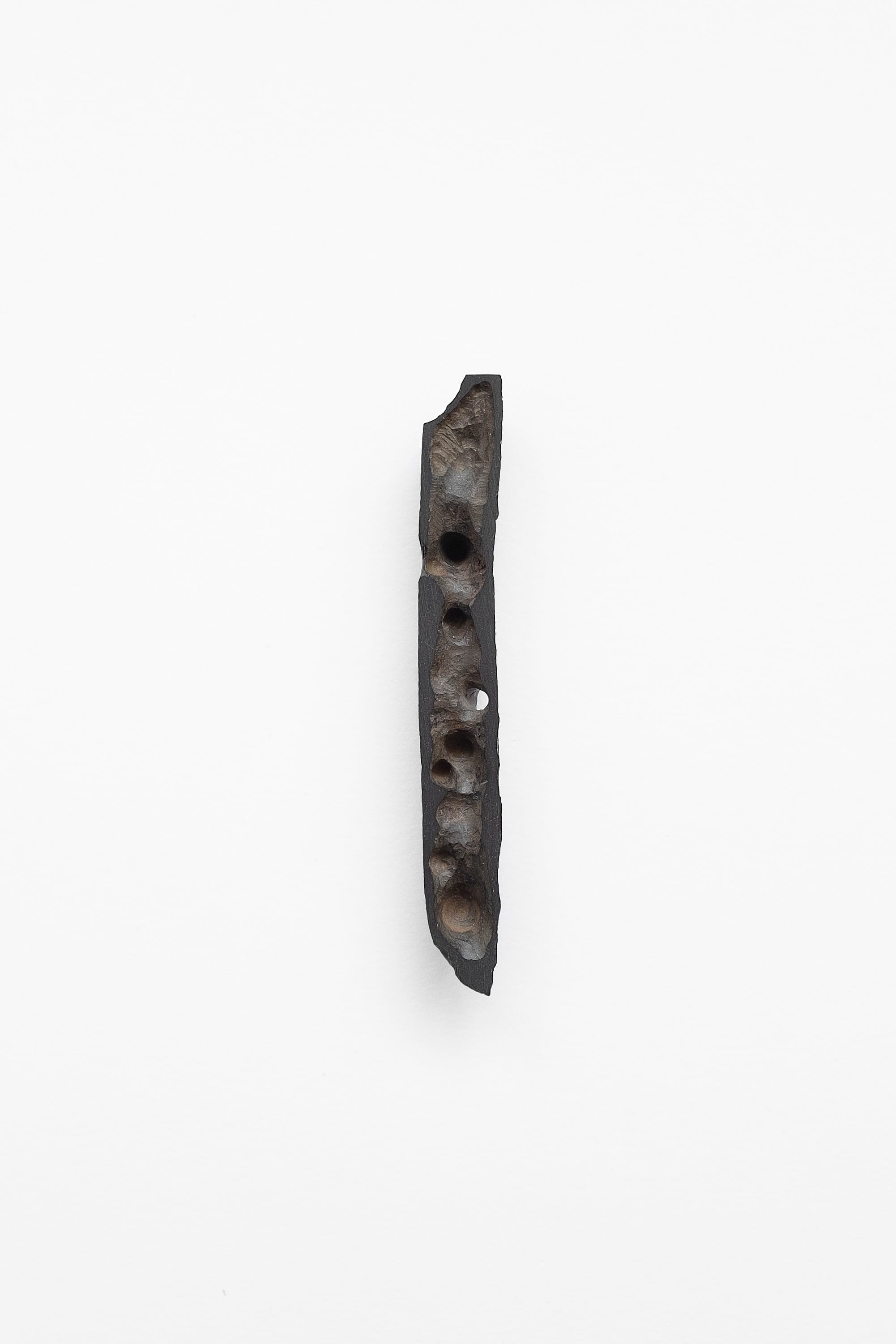
The exhibited shale works originate from the Jurassic Coast of England, where ancient seawater once saturated the rock layers. This organic-rich stone, once humanity’s primordial tinder, regains narrative agency in the artist’s hands.
Time as Material II extends the decorative traditions of Celtic Britons (c. 1200–550 BCE) of Iron Age. Shale beads bear striations that serve as grammatical markers of tectonic shifts. When the wearer’s warmth permeates the stone’s micropores, the cold mineral acquires a pulse—embodying Powell’s proposition of "time’s materiality": geological epochs and human moments reconcile through epidermal contact.
The Cavate II brooch (from Latin cavatus, "hollowed") reveals shale’s poetic dimensions. A single perforation—whether etched by seawater or bored by microorganisms—creates a delicate negative space. The stone gains levity, its void becoming a temporal wormhole linking deep history to the present. To gaze into these miniature absences is to witness nature’s subtractive sculpting, where emptiness is not lack but form.
Powell’s process is itself performative archaeology. She personally surveys coastlines, deconstructing dinosaur-era shale into contemporary adornments. As these primordial fuel-stones hang against modern skin, they become mediums for corporeal dialogue with deep time. The cavities thus cradle dual memories: echoes of Jurassic tides alongside the imprint of the wearer’s body heat—a humanizing warmth bestowed upon indifferent geological time.
III. The Rhythm of Void and Substance
Thanh-Truc Nguyen | Network
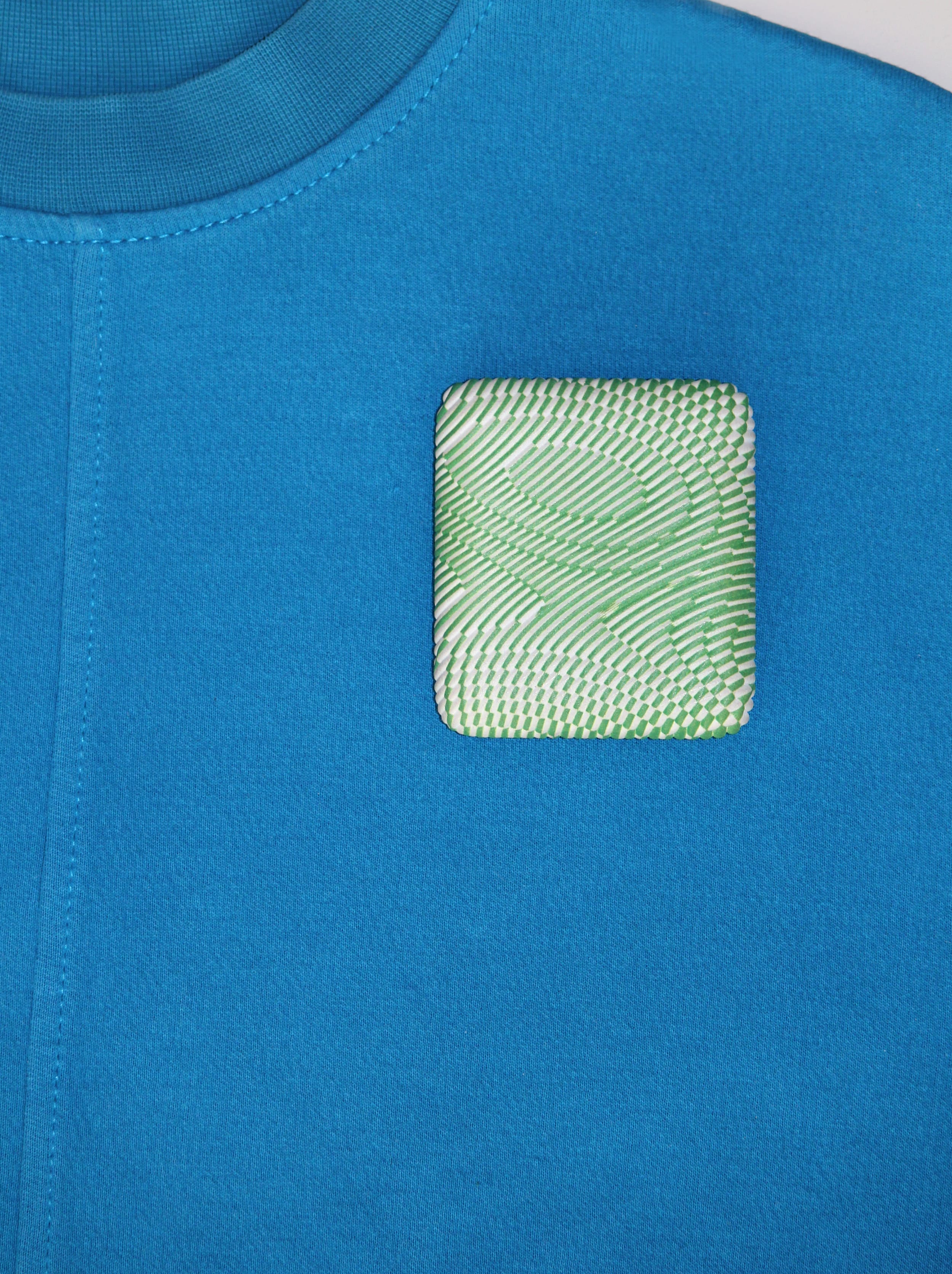
Vietnamese-German artist Thanh-Truc Nguyen employs line as syntax, weaving a taut visual poetics between Op Art’s optical illusions and today’s digital virtuality.
Trained in industrial design, her work exhibits mathematical elegance—lines repeat, intersect, and warp into kinetic networks that oscillate between 2D and 3D, mass and void.
The Network series epitomizes this paradox: densely patterned frontal matrices contrast with hollowed reverse sides, staging dialogues between "presence/absence", being/nonbeing and "tangible/intangible." The physical trajectories of her lines and their induced mental imagery become speculative instruments for probing perception itself.
Nguyen’s practice elevates industrial precision into visual poetry. Static line matrices erupt with motion, constructing vibrational fields between materiality and virtuality. This transcends traditional Op Art by incorporating the viewer’s bodily movement and psychological projection into the work’s completion. When lines cease being descriptive marks and become energy conduits, art reveals its true nature—a resonant interface between objective reality and subjective experience.
IV. The Presence of Absence
Wu Pei | I, you, he, she & Family
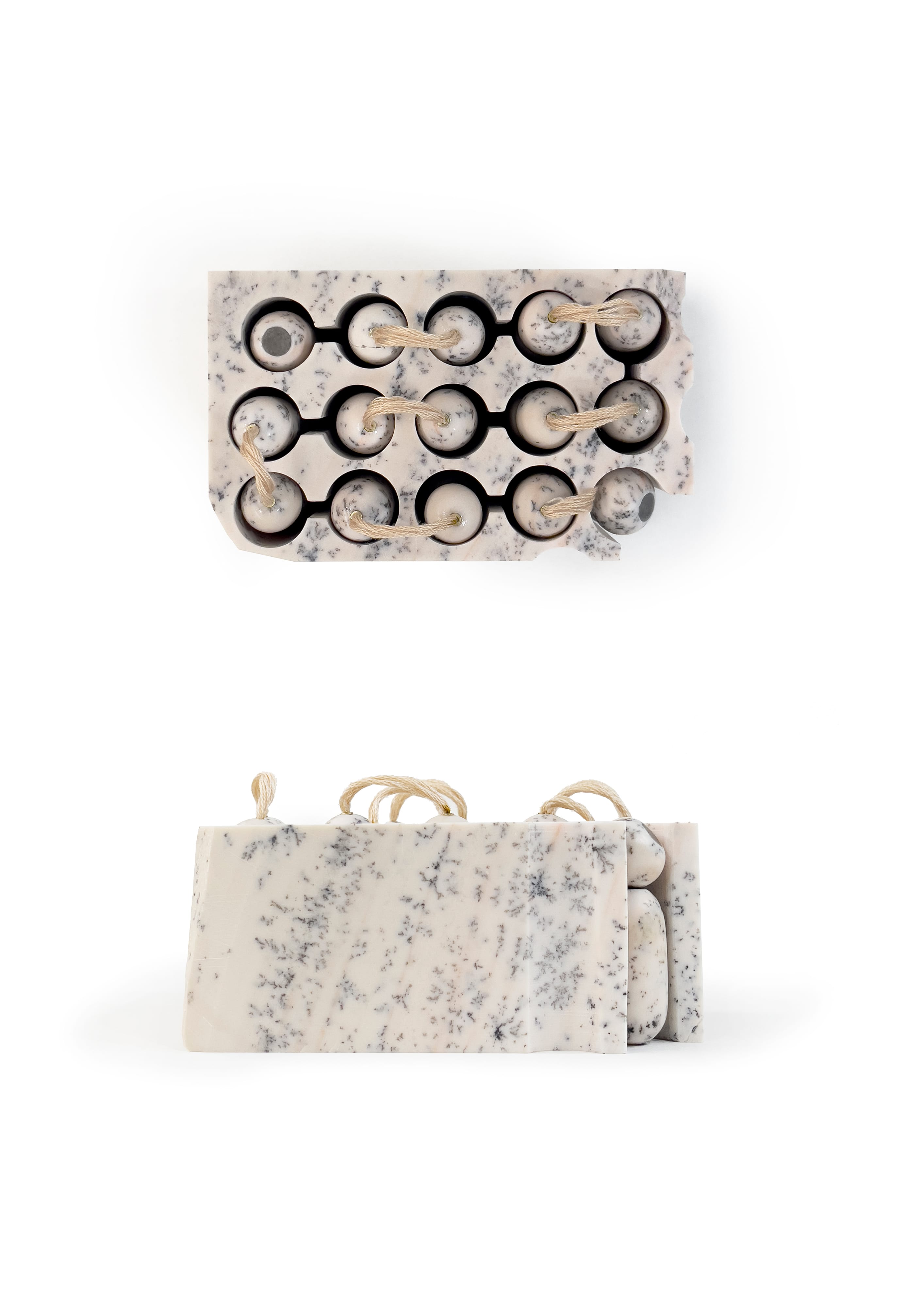
Taipei-born, Europe-educated Pei Wu conducts ontological explorations of matter and void in I, You, He, She. Using non-destructive carving techniques, she sculpts opals with millimetre precision, creating spatially complementary pairs where positive forms (stone bead chains) and negative moulds (display bases) interlock. This approach inherits traditional jade carving’s "material-guided" wisdom while achieving a trinity of "jewellery-sculpture-installation" through computational rigor—materializing a metaphysical equilibrium between presence and absence.
The Family series investigates mineral ontology. Tourmaline, Taiwanese nephrite, and serpentine are embedded in quartz matrices, their crystallographic structures engineered to manifest "being-within-being." Sunlight refraction becomes geological temporality’s self-revelation—each spectral streak a chronicle of deep time.
If “I, You, He, She” extends into East Asian lapidary philosophy, Family’s "stone-within-stone" structure mirrors Wu’s cross-cultural identity (nephrite or serpentine is "jade" in the East but "rock crystal" in the West). Both series converge on existence’s nature: the former proves void as relative presence through spatial complementarity; the latter reveals how beings inherently contain others. When carved emptiness and crystal enclosures become existential metaphors, jewellery transcends ornament to become a metaphysical vehicle.
V. The Breath of Light and Shadow
Min-ling Hsieh | Emptiness I & II
Artist Hsieh Min-Ling, also from Taipei, studied sculpture at NTUA and later at Germany's Zeichenakademie Hanau. She blends sculptural thinking with metalwork, creating a unique language.
Her signature honeycombed metals dissolve mass into ethereal lattices, where precise perforations liberate form from weight. Light penetrating these voids generates kinetic chiaroscuro, animating static objects with temporal flux.
The Emptiness I brooch exemplifies this alchemy: a jade ring suspended ambiguously within a darkened metal framework lies visually submerged until movement releases a crystalline chime—like Kant’s Ding an sich leaving auditory traces in the phenomenal world.
Hsieh’s practice embodies the Buddhist maxim: "In stillness, all motion is comprehended; in emptiness, all realms are contained." Her perforations become spiritual passageways where light continuously rewrites boundaries between matter and space. These hidden dimensions reveal themselves only through closing viewing— light tracing truth.
VI. The Materialization of Action
Yanyi Dai | Ring Toss Game I, II, III
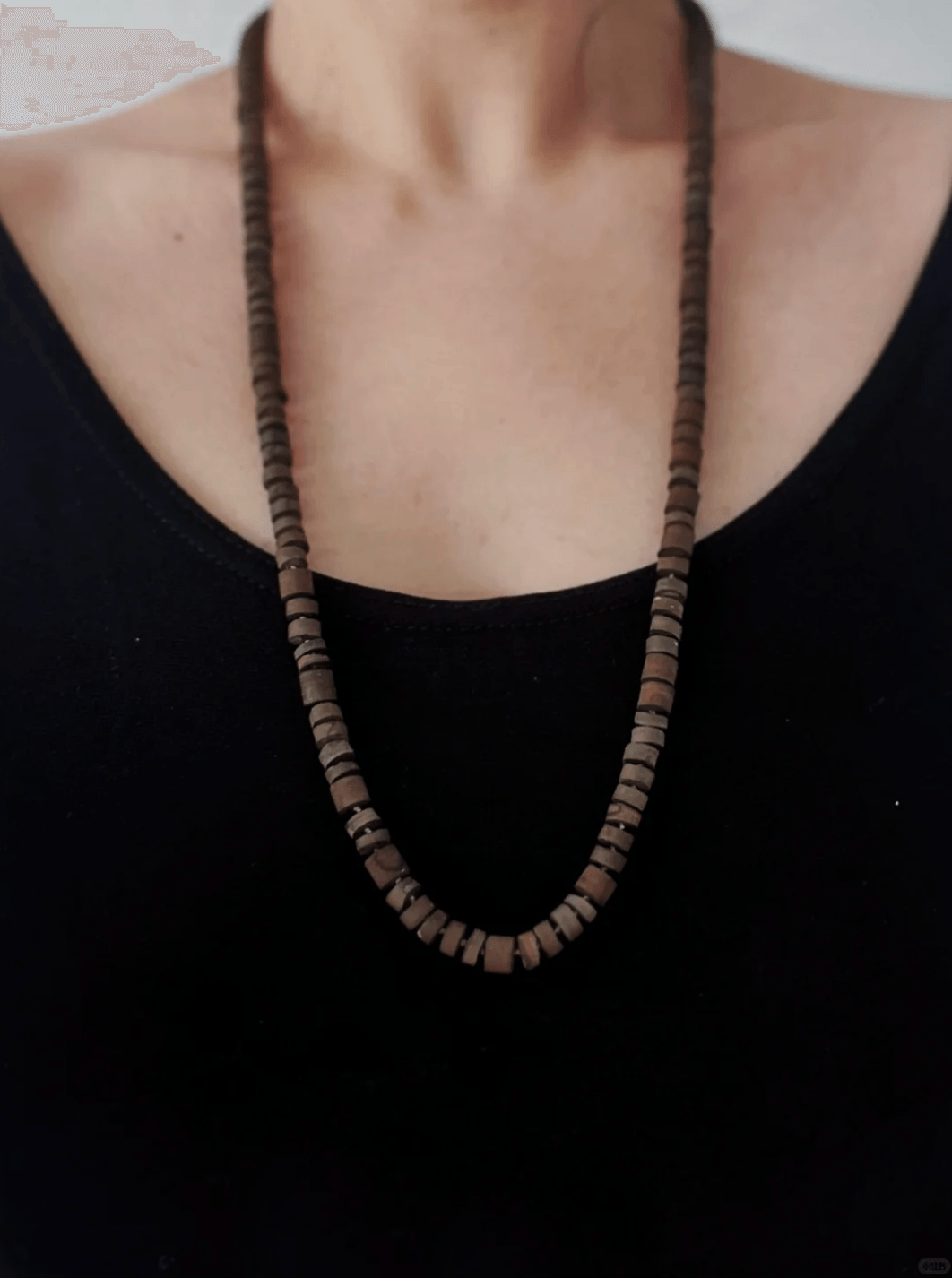
Yanyi Dai’s triptych bridges performance and materiality. Ring Toss Game III crystallizes gestures from Ring Toss Game I (a choreography of jumping through hoops) into a necklace using image-slicing technology—preserving movement in form.
Ring Toss Game II constructs participatory theatre where visitors trigger ring-tossing mechanisms, unwittingly entering the artist’s preordained system. This nested critique mirrors social structures where individuals negotiate imposed rules.
The original Ring Toss Game I subvert bead necklace’s passive wearing into active bodily engagement—wearers simultaneously become rule-makers and followers, exposing contemporary "voluntary shackles" through seemingly playful acts.
Together, the trilogy forms a conceptual device: materially translating performance into wearable piece while offering visual allegories of societal mechanisms.
Epilogue
Beyond these six works, the exhibition’s hundred-plus pieces collectively construct a spiritual dojo for contemplating being. Their pores—piercing material husks—carve breathing space for souls in an age of material and informational suffocation. Art historically, Kuan Fan’s inkless waterfall in Travelers Among Mountains and Streams (990–1030) and Rachel Whiteread’s resin-cast architectural voids (House) form a trans-temporal dialogue on "the marvel of emptiness." Going even deeper, James Turrell’s light installations (Roden Crater) guide viewers to step directly into the "hollow," using the physical body to verify: emptiness is not void, but a perception vessel brimming with light.
The Hole extends this discourse through contemporary jewellery: bone cavities as biological negative space; opal refractions as optical paradoxes; shale perforations as geological archives. Even when gallery lights dim, the light through Hsieh's works and the mineral memories trapped in Wu’s tourmalines persist in afterimages. In our hyper material present, art’s value may lie precisely in these strategic voids—as Zen wisdom holds: Only where emptiness is perceived can all things truly arise.
For the original essay document please refer to the following link:
https://drive.google.com/file/d/1aMhlr51ZGu8fLCn-QOThRkvJc2EiMA1v/