Zoé Kiner-Wolff
‘Jewellery trouble : Embodied Jewellery or the Disappearance of the Object ’
CV
Short Bio
Zoé Kiner-Wolff is a doctoral student in art history at Paris 1 Panthéon Sorbonne University, focusing on jewellery as an artistic medium. Her PhD thesis is entitled ‘Body Jewellery. The new physicalness in jewellery art. From 1967 to the present day’
She studies artists who question the relationship between jewellery, body and wearability by exploring forms of performative adornment.
At the same time, Zoé is an artist who focus on the adorned body and on metamorphosis in appearance of beings and objects. She creates jewellery, masks and costume to transform the body and explore plural identities.
Abstract
‘Jewellery trouble : Embodied Jewellery or the Disappearance of the Object ’
Abstract
As part of body jewellery movement that began in the late 1960s in the field of jewellery as art,
a phenomenon of incorporation of jewellery into the body can be identified. In this way, the jewellery artists develop a conceptual approach, echoing Body art on the one hand and social practices of body modification on the other. They use the material of the body and the meanings of their medium. And they create jewellery embedded in the body by the mark left on the skin, by using bodily material to create jewellery on or under the skin, and by inserting jewellery deep into the body. Gradually, the jewellery seems to disappear, giving way to the body, which raises questions about the status of jewellery, objects and the adorned body.
This study is based on examples selected from numerous cases of Embodied jewellery, starting with Gijs Bakker’s Shadow Jewellery, continuing with jewellery printed on skin by Tiffany Parbs. Then the mark becomes a wound with Lauren Kalman or Åsa Skoberg’s works. Finally, through the use of medical technology, artists such as Norman Cherry, Peter Skubic and Frédéric Braham seem to make the jewellery disappear completely into the body.
Keywords
Body jewellery ; Embodied jewellery ; Performance ; Body related object ; body modification
Text
‘Jewellery trouble : Embodied Jewellery or the Disappearance of the Object ’
Introduction
Since the second half of the twentieth century, jewellery as an artistic practice has been structured around a community of specialists, schools and institutions. As such, jewellery artists, who are trained and then go on to teach at the jewellery workshops in art schools, are supported by a network of collectors and galleries, museums and fairs (1). In this field of jewellery as art, I study the specific work of artists who
question the way jewellery relates to the body and to wearability.
From the end of the 1960s, artists began to developing spectacular or performative jewellery pieces that were impossible to wear in everyday life from a Western perspective. This approach shifts the experience of wearing a jewel, which is no longer an ornamental accessory. In this way, these artists move away from the traditional definition of jewellery (2) and develop a conceptual approach to their medium.
However, the body remains at the heart of the thinking of artists. On the one hand, the connection with the body seems to be the ultimate element that defines jewellery. Considering jewellery as a “body related object” may be the only way to describe it in a global perspective (3). On the other hand, the end of the 1960s marked a turning point in jewellery art, when « the new physicalness in the visual arts contributed to jewellery artists beginning their search for a more direct relationship with the body » (4) as the art historian Liesbeth den Besten wrote in her book On Jewellery (2013) .
Indeed, a “body jewellery” movement is developing alongside the rise of body art. There seems to be a correlation between the emergence of artistic practices involving the body – such as happenings, performances, actions and events – and those of jewellery artists who create pieces designed to be activated during performances. Furthermore, this phenomenon is also part of a broader trend towards the spread of body modifications in subcultures within contemporary Western societies (5). Finally, by shifting the focus, these Body jewellery become part of the vast field of body adornment in a variety of
cultural areas (6).
By studying the work of these jewellery artists, it appears that this direct relationship with the body has consequences for the form of jewellery and transforms the status of the object.
At this point, a trouble begins between the body and jewellery, visible in certain artists who question the place of the body as an empty canvas. Some artists mark the skin so well that the imprint or inscription becomes the jewellery, or they cross the boundaries of the skin to embedded the jewellery, which enters
the flesh and gradually disappears into the body. By using the organism as a creative material, these jewellery artists overturn the relationship between jewellery and the body, and in doing so, question their limits and common boundaries.
What happens then if the jewellery disappears and the body now occupies the main place?
In this paper, I would like to study this subversion of jewellery and the body as a particular phenomenon of Body Jewellery.
In the Shadow of Organic Jewellery
On contact with skin, jewellery is an object linked to the body ‘directly, crudely, sensually, through purely epidermal communication.’ (7). Among body jewellery artists, this connection is accentuated when the jewellery is inscribed directly into the flesh. This investigation of the epidermis is full of meaning, because ‘the skin encloses the body, the boundaries of the self, establishing the boundary between inside and outside in a living, porous way, because it is also an opening to the world, a living memory’ (8), as written by sociologist David Le Breton (9).
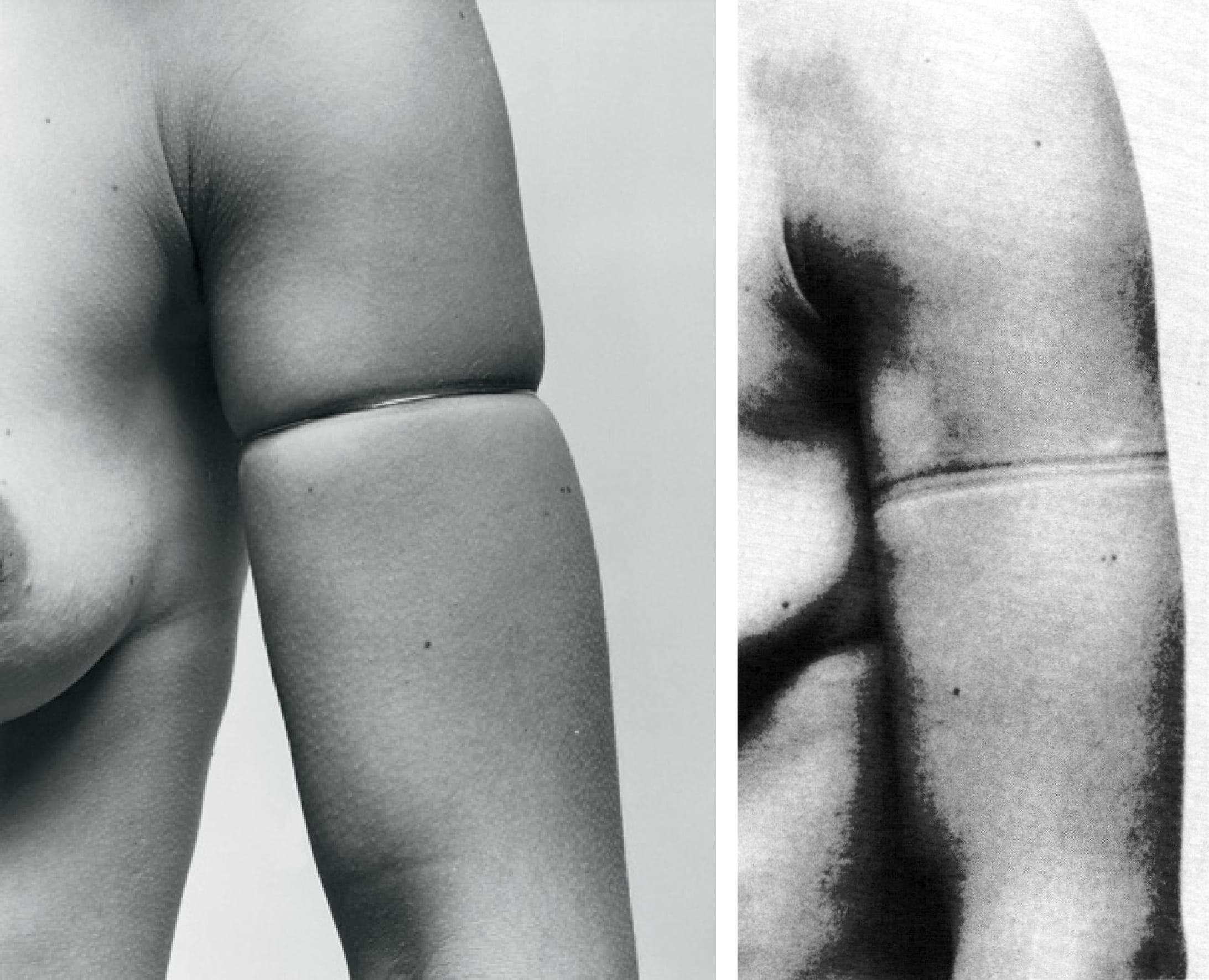
It is this plastic memory of the body that Gijs Bakker uses in concrete terms in his Shadow Jewellery (1973). This series of photographs taken by Ton Baadenhuyzen shows parts of the body – one arm, one back, two ankles – with the mark of a bracelet or a ring imprinted on the skin by a wire that encircles the body. The original title, Organic Jewellery, conveyed the idea that it is the mark left on the body that becomes the jewel itself, while the second title – Shadow Jewellery – emphasises the disappearance of the object. It is noteworthy that Gijs Bakker chose to change the title when the bracelet was reissued in gold for an exhibition, highlighting the paradox of this piece of jewellery, which is both immaterial and hyper-physical.
This example open the gate for a whole range of skin mark jewellery, which are like temporary scarifications or tattoos, immortalised by the photograph.
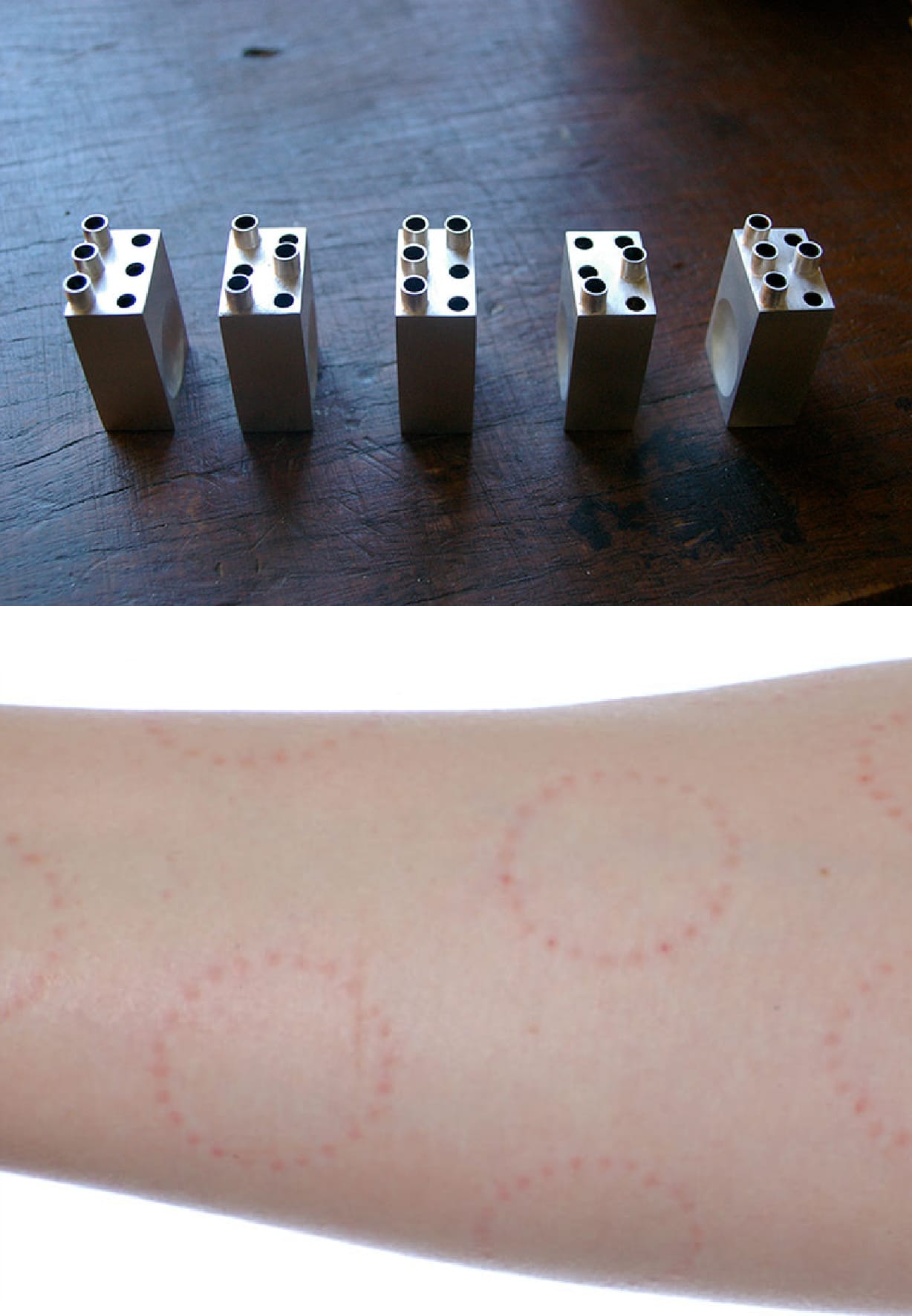
Thus, jewellery artist Tiffany Parbs create stamps to make inscriptions on the body. She plays with words with Rash Stamps (2004) from her Marked serie: the object looks like a ‘stamp’, when pressed against the skin, it leaves a red mark like a ‘rash’, which can be seen in the photograph by Greg Harris. In
this case, the jewellery is definitely a mark on the body; the object is more of a tool. However, on the pieces entitled Inflame, from Bind serie (2009), there are hollow spaces designed for the fingers to hold the typographic characters. This detail demonstrates the attention paid to the body and gesture in the
design. All of Tiffany Parbs’ work « focuses on expanding existing definitions of jewellery using her body as a primary reference point » (10), as she herself states.
Faced with these organic jewels, formed by the traces and shadows left on the skin, the boundaries between what is body and what is jewellery become blurred. The question of the status of the object arises: Is the work the ephemeral mark left on the body, the jewellery-tool that made the mark, or the
photograph that preserves it?
Into the Flesh
As anthropologist Enid Schildkrout remarks, ‘bodily inscriptions are all about boundaries’ (11), some jewellery artists, such as Lauren Kalman, cross this border to develop jewellery ‘for the body and about the body’ (12).
Lauren Kalman uses photographic staging to create jewellery that interacts with the adornment or material – such as gold, pearls, glass – the body and its fluids: saliva, tears, blood and so on.
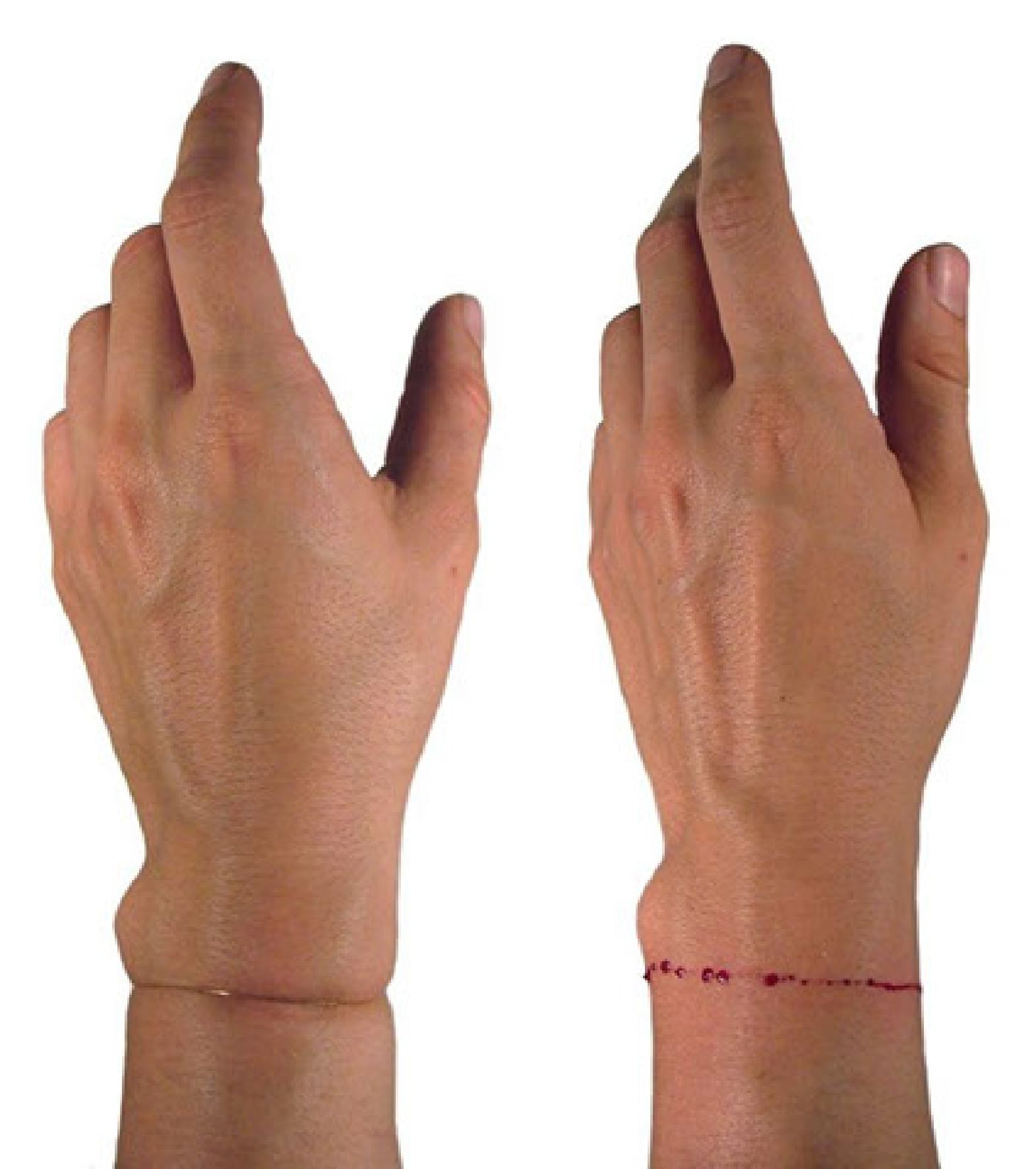
With two of her photographs – Gold Bracelet (2006) and Bracelet (2006) – she creates a fictional narrative by juxtaposing two images of hands taken with the same framing. On the wrist of the first one there is a gold bracelet deeply embedded in the flesh, on the second one, in the same place, there is a bracelet
made of blood pearls. Thinking about Gijs Bakker’s Shadow Jewellery, it looks like ‘the wire appears painfully thin and tight and looks as if it could sever the bound skin’ (13). But it is actually with the help of a razor blade, which is not shown, that Lauren Kalman brings forth these pearls of blood around her
wrist. Even if the pain is less severe than it appears, this piece of jewellery has a strong visual impact, because ‘shedding blood is a [...] taboo that is being broken, while for many of our contemporaries, just seeing it causes fainting or fear’ (14).
Because the body is full of meaning, just as jewellery is a cultural and symbolic artefact, this Embodied jewellery can carry a message.
In this way, Åsa Skoberg explores feminist issues in her work by playing with the symbolism of jewellery.
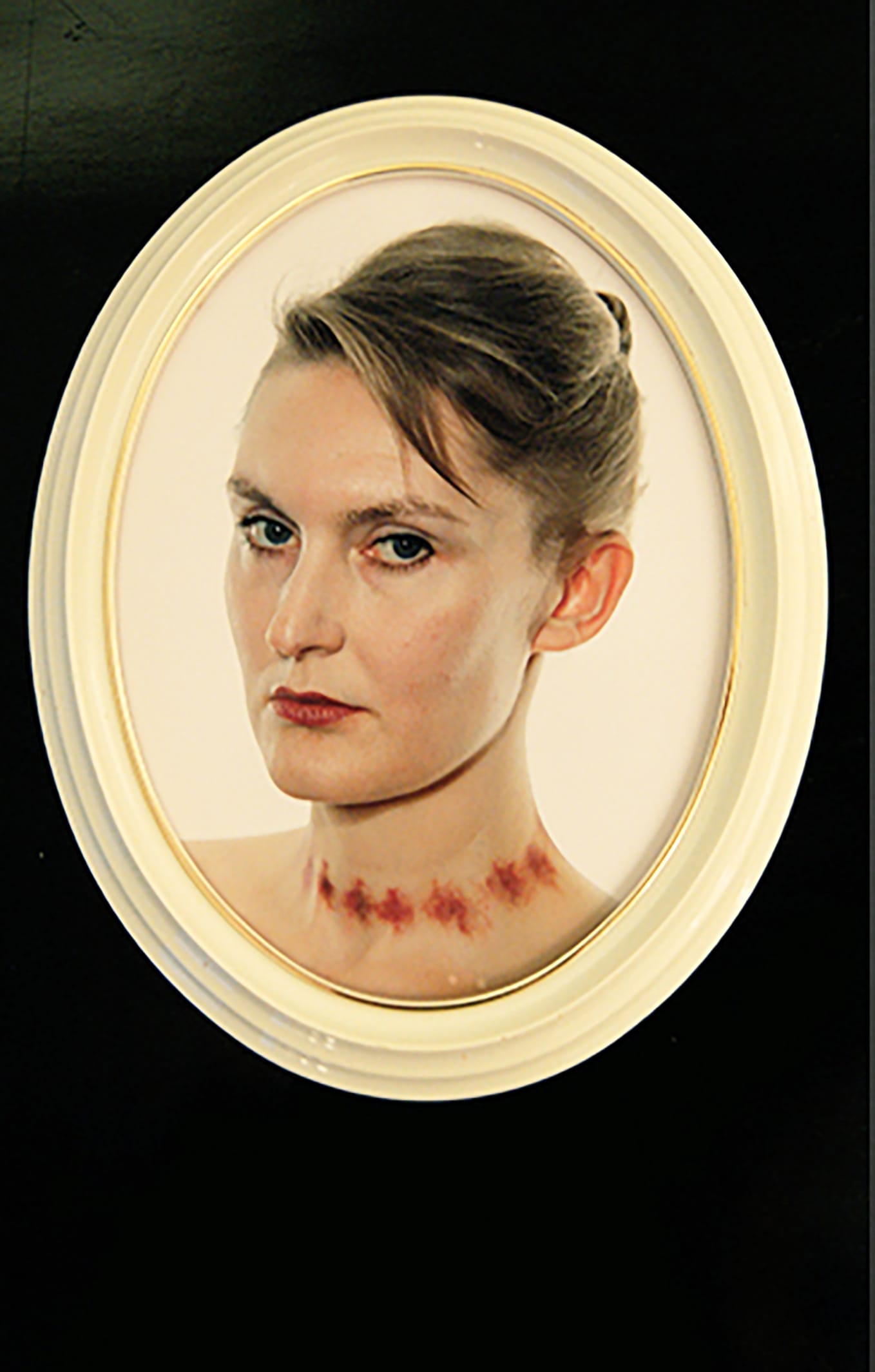
I want Pearls (1998) is a portrait of a young woman wearing a necklace of love bites. These bloody pearls appear as the stigmata of male domination over women’s bodies, by subverting a sexual act and the pearl necklace that symbolises the wife’s attachment to her husband. The title – I want Pearls – contrasts with the chilling effect of the image and screams out the violence of patriarchal social norms. No tools other than the mouth are needed to make this necklace, yet it is the history of the jewellery that gives meaning to this art work.
These examples demonstrate the emergence of an ‘an art whose material is the body” (15) in jewellery.
Although these bodily modifications are generally temporary for jewellery artists, the use of photography allows them to create works that showcase the body adorned with its own substance.
Schmuck unter der Haut • Jewellery Under the Skin
Having transgressed the boundaries of the skin, jewellery artists continue their investigation into the body, using the means provided by surgery and medicine to reach the innermost depths of the body, where the jewellery dissolves.
Norman Cherry’s Angiogenetic Body Adornment (2004) are only visible as subcutaneous growths. Similar to the transdermal implants used in Bodmods, the jewellery blends under the skin, transforming the shape of the human body. Norman Cherry uses medical research on angiogenesis, and ‘taking its name
from ‘angiogenesis’, the natural process by which tissue is made, the ‘jewellery’ is constructed from the substance of the body itself’ (16). Nevertheless, it is difficult to know whether these photographs are actual experiments or mere hypotheses, a question raised by the artist himself (17).
Here again, images are used to construct a narrative in which the jewel is created with the material of the body. Furthermore, jewellery is increasingly being incorporated into the body, entering beneath the skin and becoming less and less visible.
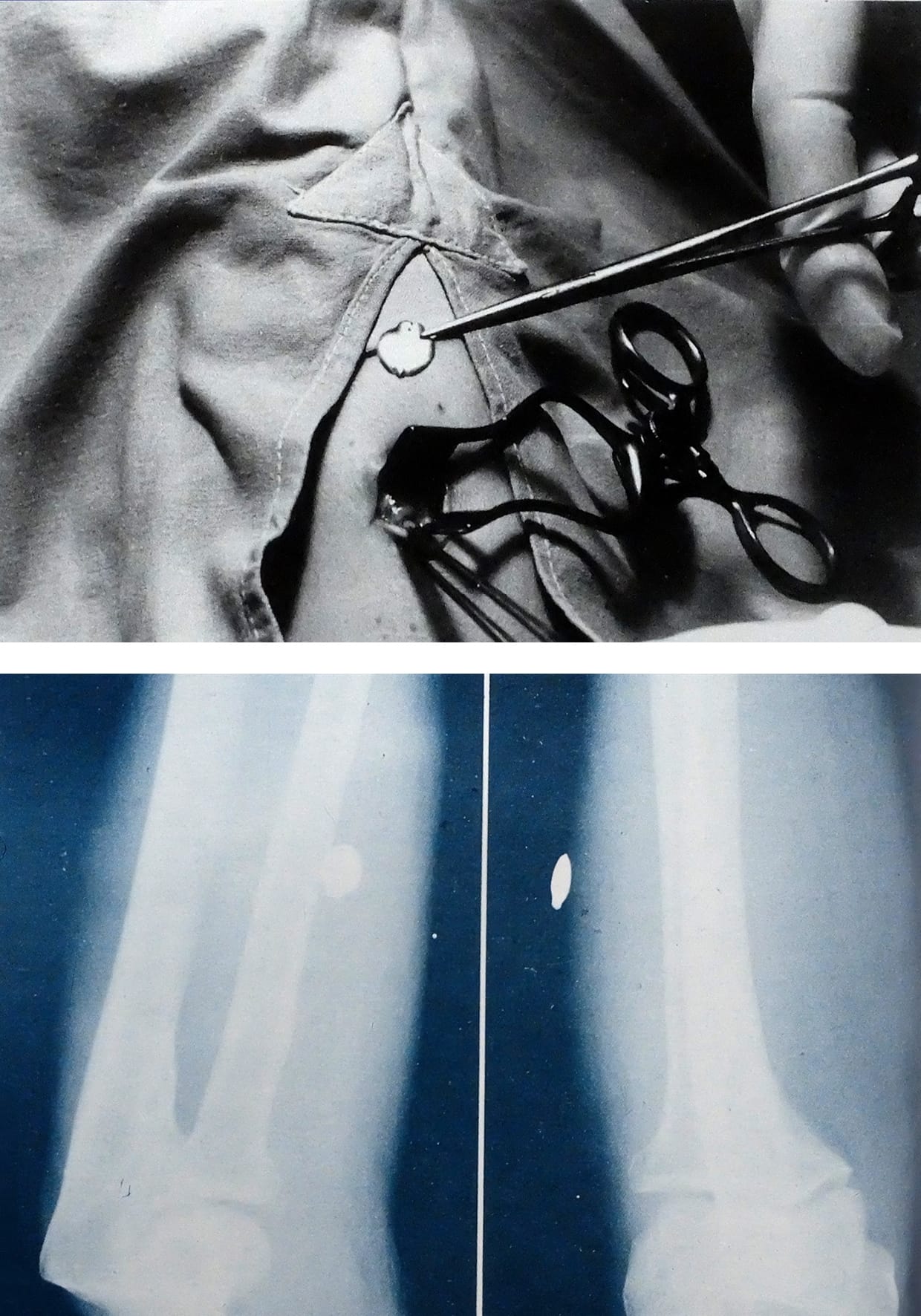
In Schmuck unter der Haut (1975-1982) by Peter Skubic, the implant entirely disappears into the body, placed under the skin of his forearm during surgery on 4 November 1975. The photographs of the surgical operation and the X-ray images of the implant in the artist’s arm document the performance,
comparable to the use of images in the work of the artist Orlan (18), for whom ‘the operating theatre becomes a studio and the surgical procedure becomes a performance, but also part of the work presented’ (19). On 27 May 1982 a second operation was performed to remove the piece of metal from the artist’s arm and seal it in a coffin-shaped ring. While there is a return to the material and visual form of jewellery, images and performance remain at the heart of the artist’s approach (20).
If the implant that Peter Skubic wore for seven years is a simple metal pellet, the materiality of Inner Beauty (2000-2011) by Frédéric Braham is even more tenuous.
The jewellery artist borrows from the world of medicine 72 ingestible homeopathic dilution of gold, silver, copper, ruby, diamond, etc. transforming it into jewellery with references to its iconic materials.
These drinkable solutions contain a tiny amount of gold granules or diamond drops, but when transferred to the world of jewellery, they acquire a symbolic value: an ‘inner beauty’. It is also an inner beauty that adorns the person who drinks the solution. The jewel then becomes something imperceptible, a transparent liquid, an inner and undetectable ornament that remain during digestion until it is naturally eliminated by the body. Or perhaps jewellery becomes something more symbolic:
like a magic potion that reveals the inner beauty of the person wearing it.
Through this gradual disappearance of the object and the adorned body, it is the symbolic power of jewellery that remains. These artists develop a conceptual approach to the meanings and intrinsic values conveyed by jewellery, such as amulets, in relation to the body through performance and image.
Conclusion
Throughout this study, it becomes obvious that Embodied jewellery differs radically from the traditional definition of jewellery: it is no longer an ornamental accessory. A parallel can be drawn with social practices involving body modification which ‘differ from traditional jewellery in that piercings
and tattoos require penetration of the skin’21. Thus, for ethnologist Bruno Rouers, ‘body marks are therefore jewellery with added value’22. This reflection may apply to Embodied jewellery, which is both jewellery becoming-body and body becoming-jewellery.
Despite its apparent disappearance and ephemeral nature, this jewellery is highly visual and physical thanks to the use of images. As a result, this jewellery is embodied on several levels: by leaving a trace on the body and on the photograph, thanks to ‘its intrinsic quality as exposed film, which makes it similar
to the retina, the most sensitive tissue in the body’23. From this perspective, the image can be seen as a ‘second skin’, an extension of the body and the jewellery, on which the imprint of the Embodied jewellery is now fixed forever.
•
1). This state of affairs reflects ‘all the concrete processes that make – and not just say – something art’, a characteristic of the
phenomenon of artification coined by sociologists Nathalie Heinich and Roberta Shapiro. cf. N. Heinich, R. Shapiro (dir.), De
l’artification. Enquêtes sur le passage à l’art, Paris : EHESS, 2012.
2). By developing new forms of jewellery, some artists are moving away from the traditional definition which considers jewellery to be « a decorative objects worn on clothes or on the body, such as rings and necklaces, often made from valuable metals and containing precious stones ». What’s more, the French dictionary Le Nouveau Petit Robert, dictionnaire de la langue française (2007) emphasises the preciousness and small size of jewellery as a decorative object, an accessory. This definition reflects a conception of jewellery based on its common use in modern and contemporary Western society. But it effectively excluded a large proportion of creations from other socio-cultural contexts, as well as a significant proportion of works by contemporary jewellery artists. My doctoral research therefore involves searching for another, more comprehensive definition of jewellery.
3). For example, according to Michèle Heuzé, an art historian specialising in contemporary jewellery, ‘defining jewellery without the body is to equate it with any other object and strip it of its identity’ (« définir le bijou sans le corps, c’est l’assimiler à n’importe quel objet et lui retirer son identité ») in: M. Heuzé, « Préciosités », in: F. Bodet, Dans la ligne de mire, cat. exp., Paris :
Broché, 2013 _ p. 17.
4). L. den Besten, On Jewellery : a Compendium of International Contemporary Art Jewellery , (ed.) Stuttgart: Arnoldsche, 2011 _ p. 128
5). Regarding bodily modifications in contemporary Western societies, I refer to, among other sources: the authors of the
Quasimodo journal, the research of sociologist David le Breton, or the essay on the punk movement by Dick Hebdige, Subculture: The Meaning of Style (1979).
6). These body modifications in different cultural areas have been studied by numerous researchers, historians and
anthropologists, such as Marcel Mauss, who includes jewellery in the category of adornments, meaning ‘the addition of ornaments to the body’. cf. Marcel Mauss, « Les techniques du corps », in: Journal de psychologie, n°32 (3-4), Sociologie et
anthropologie, (ed.) Paris : PUF (1936), 1950. _ p. 144-148.
7). Michel Thévoz, Le Corps peint, op. cit. _ p. 26
8). David Le Breton, « Les scarifications comme anthropologiques », in: Gilles Boetsch et al., Corps normalisé, corps stigmatisé, corps racialisé, (ed.)Louvain-la-Neuve : De Boeck Supérieur, 2007 _ p. 157 : « La peau enclôt le corps, les limites de soi, elle établit la frontière entre le dedans et le dehors de manière vivante, poreuse, car elle est aussi ouverture au monde, mémoire vive. »
9). Bernard Andrieu, Gilles Boëtsch, David Le Breton, Nadine Pomarède, Georges Vigarello, La peau. Enjeu de société, (ed.) Paris: CNRS éditions, 2008
10). cf. Tiffany Parbs website — https://www.tiffanyparbs.com/about _ accessed on 14/07/2025
11). Enid Schildkrout, « Inscribing the Body », in : Annual Reviews of Anthropology, Vol. 33, 2004, pp. 319-344 _ p. 338 : « Second,
bodily inscriptions are all about boundaries, a perennial theme in anthropology – between self and society, between groups,
and between humans and divinity. »
12). Liesbeth den Besten, On Jewellery : a Compendium of International Contemporary Art Jewellery , (ed.) Stuttgart: Arnoldsche, 2011 _p. 133
13). Lauren A. Kalman, Pain and Purification: the application of gold to the skin, thesis, Master of Fine Arts, Graduate School of The Ohio State University, supervisor Amy M. Youngs, 2006, p. 1
14). David Le Breton, « Les scarifications comme anthropo-logiques », in : Gilles Boetsch et al., Corps normalisé, corps stigmatisé, corps racialisé, (ed.) Paris : De Boeck Supérieur, (coll.) « Hors collection », 2007, p. 163 _ ‘faire couler le sang est un […] interdit transgressé alors que pour nombre de nos contemporains sa seule vue provoque l’évanouissement ou l’effroi’.
15). Claude Chippaux, « Sociétés et mutilations ethniques », In: Bulletins et Mémoires de la Société d’anthropologie de Paris, XIII° Série. T.9, 1982 _ p. 258 : « art dont le corps est la matière »
16). Beccy Cheng et Clarke Indigo, New Directions in Jewellery II, op. cit. _ p. 70 : « Taking its name from ‘angiogenesis’, the natural process by which tissue is made, the ‘jewellery’ is constructed from the substance of the body itself. »
17). Norman Cherry, « Living Art – Angiogenetic Body Adornment », an updated and revised paper with new visual proposals, originally published in Journal of Media Arts Culture 3: 3, December 2006 _ https://fusion-journal.com/issue/002-fusion-thelimits-of-virtuality/living-art-angiogenetic-body-adornment/ _ accessed on 15/07/2025 : « Illustrations 6, 7, 8 (Figures 6, 7,8) are examples of what might be created for and by adults applying the principles I have described. Are these just flights of fancy? The products of the fevered imagination of a deluded academic? Just science fiction? Or might I just be predicting a real future? »
18). Orlan is a French performing artist who developed ‘the Carnal Act’ / ‘l’Art Charnel’ started during the 1990s: some
transformations of her body and appearance through surgical-operation-performances, filmed and live-streamed in galleries
and museums in New York, Paris and Toronto._
cf. https://www.orlan.eu/bibliography/carnal-art/
19). David Le Breton, L’Adieu au corps, (ed.) Paris : Éditions Métailié, 1999 _ p. 49 : David le Breton On body art and Orlan’s work : « La scène opératoire devient un atelier et l’intervention chirurgicale le spectacle mais aussi une part de l’oeuvre présentée»
20). cf. The 3.28 minutes movie Extraction by Wilhelm Graube, made during the surgical operation on 27 May 1982.
21). Bruno Rouers, « Les marques corporelles des sociétés traditionnelles : un éclairage pour les pratiques contemporaines », in: Psychotropes, vol. 14, (ed.) Paris : De Boeck Supérieur, 2008, pp. 23-45 _ p. 39 : « La différence par rapport au bijou classique réside dans le fait que la pose de piercings ou l’encrage nécessitent de pénétrer la peau. […] la marque corporelle constitue donc un bijou à valeur ajoutée. »
22). Ibid
23). Michel Thévoz, Le corps peint, (ed.) Genève : Skira, 1984 _ p. 8 : « la photographie même, procédé objectif s’il en est, paraît
s’être attachée depuis une décennie à rappeler sa qualité intrinsèque de pellicule impressionnée, qui l’assimile à une rétine c’est-à-dire au tissu le plus sensible du corps ».
Selected bibliography
• Gil BARTHOLEYNS, « Les apparences de l’homme. Penser l’objet et l’ornement corporels _ Introduction.
Faire de l’anthropologie esthétique », in : Civilisations, Revue internationale d’anthropologie et de sciences humaines,
n° 59-2, (ed.) Bruxelles : Université libre de Bruxelles, 2011 _ En ligne : http://journals.openedition.org/
civilisations/2567 ; DOI : 10.4000/ civilisations.2567
• Liesbeth den BESTEN, On Jewellery : A Compendium of International Contemporary Art Jewellery, (ed.) Stuttgart :
Arnoldsche, 2011.
• Liesbeth den BESTEN, « Artists, Galleries and their Relationship(s). In Sight Series / High Expectations,
Part 2/3. », in: Art Jewelry Forum, revue online, 25. 05. 2013. _ https://artjewelryforum.org/articles/in-sightseries-
high-expectations-artists-galleries-and-their-relationships-part-23.
• Gilles BOETSCH (et al.), Corps normalisé, corps stigmatisé, corps racialisé (1967), (ed.) Louvain-la-Neuve : De Boeck
Supérieur, (coll.) « Hors collection », 2007
•Quasimodo Association (ed.), Quasimodo, N° 7 « Modifications corporelles », 2003, (ed.) Paris : Quasimodo
& Fils _ en ligne : www.revue-quasimodo.org/Quasimodo%20-%207_Modifications.htm
• David Le BRETON, Signes d’identité. Tatouages, piercing et autres marques corporelles, (ed.) Paris : Métailié, 2002.
• David Le BRETON, L’Adieu au corps, (ed.) Paris : Éditions Métailié, 1999
• Denis BRUNA, Piercing : Sur les traces d’une infamie médiévale, (ed.) Paris : Broché, 2001, dédié au piercing.
• Claude CHIPPAUX, « Sociétés et mutilations ethniques », In: Bulletins et Mémoires de la Société d’anthropologie de
Paris, XIII° Série. T. 9, 1982 _ p. 258
• Susan COHN, Peter DORMER, Deyan SUDJIC, Unexpected pleasures. The art and design of contemporary jewellery,
(ed.) New York : Rizzoli international Publication, 2012.
• Alain CORBIN, Jean-Jacques COURTINE, Georges VIGARELLO (dir.), Histoire du corps, 3 vol., ed : Paris
Seuil, 2005.
• Thomas J. CSORDAS, Embodiment and Experience: The Existential Ground of Culture and Self, (ed.) Cambridge :
Cambridge Univ. Press, 1994
• Anne DRESSEN, Michèle HEUZÉ et Benjamin LIGNEL (dir.), Medusa. Bijoux et tabous, cat. exp., (ed.) Paris :
Paris Musées, 2017.
• Joanne ENTWISTLE, The Fashioned Body: Fashion, Dress and Modern Social Theory, Paris : Broché, 2000.
• Elizabeth FISCHER, « Jewellery, ornament and body equipment », in: Russian Fashion Theory, (ed.) London :
Bloomsbury Publishing, (coll.) « Accessories special issue », 2010.
. Dick HEBDIGE, Sous-culture. Le sens du style (1979), (ed) Paris : La Découverte, (coll.) Zones, 2008
• Sylvie LAMBERT, Le bijou contemporain : son rapport au vêtement et à l’art. Anthropologie de l’ornement en Europe depuis
les années 1960, Sous la direction de Pierre-Yves Balut, Université Paris-Sorbonne, dans le cadre de École
doctorale Histoire de l’art et archéologie, en partenariat avec le Centre André Chastel, Paris, 2012.
• Benjamin LIGNEL (dir.), On and Off : Jewelry in the Wider Cultural Field, (ed.) San Francisco : Art Jewelry Forum,
2016.
• Benjamin LIGNEL, Shows and Tales. On Jewelry Exhibition-Making, (ed.) San Francisco : Art Jewelry Forum, 2015.
• Philppe LIOTARD, « Modifications corporelles », in : Quasimodo, N°7, (ed.) Carnon : Quasimodo & Fils,
2003.
• Bruno ROUERS, « Les marques corporelles des sociétés traditionnelles : un éclairage pour les pratiques
contemporaines », in : Psychotropes, 2008, Vol. 14, pages 23 à 45, (ed.) De Boeck Supérieur
• Enid SCHILDKROUT, « Inscribing the Body », in: Annual Reviews of Anthropology, Vol. 33, 2004
• Damian SKINNER (dir.) Contemporary Jewellery in Perspective, (ed.) Asheville : Lark books and Art Jewellery
Forum, 2013.
• Damian SKINNER, « All the world over : The global Ambitions of Contemporary Jewelry », in: Art
Jewelry Forum, revue online, 2012 _ https://artjewelryforum.org/articles/all-world-over-global-ambitionscontemporary-
jewelry-0.
• Michel THÉVOZ, Le Corps peint, (ed.) Genève : Skira, 1984
• Ralph TURNER, Contemporary jewelry: A critical assessment 1945-75, (ed.) Londres : Studio Vista, 1976
• Marjan UNGER, Jewellery in Context. A Multidisciplinary Framework for the Study of Jewellery, (ed.) Stuttgart :
Arnoldsche, 2019.
• Donald WILLCOX, Body Jewelry : International Perspectives, (ed.) Chicago : H. Regnery, 1973.
Images
1. Gijs Bakker, Shadow Jewellery (Organic Jewellery), 1973, photo © Ton Baadenhuysen
2. Tiffany Parbs, inflame, série Bind, 2009, outils en braille pour la peau, 40 x 20 x15 mm (chacun),
photographie deTiffany Parbs
Tiffany Parbs, Rash stamps, série Marked, 2004, argent massif, peau, dimensions variables, photographie de
Greg Harris
3. Lauren Kalman, Gold Bracelet, série Hard Wear, 2006, impression numérique, 24 x 34 pouces
Lauren Kalman, Bracelet, 2006, impression numérique, 24 x 34 pouces
4. Åsa Skoberg, I want Pearls, 1998, photography
5. Peter Skubic, Schmuck unter der Haut, 1975-1982, photographs of the surgical operation on 4 November 1975:
insertion of the implant; X-ray of the implant in the arm of the artist.
For the original essay document please refer to the following link:
https://drive.google.com/file/d/1nVZUY0xyLe9CtZi10U8zADSvdpgT4VFg/