Zoe Clark
Before Speech, Beyond Silence: Reflections on authorship, ambiguity and encounter in contemporary jewellery dialogue.
CV
Short Bio
Zoe Clark is a London-based artist and jeweller whose practice spans writing, metalwork, and stone carving. Rooted
in research, her work places equal emphasis on text and making, often exploring the intersection of human perception
and the overlooked. Drawing from shared experiences, she subtly subverts dominant narratives, creating space for
objectivity and inviting a reexamination of established perspectives. She produces reflective essays on art jewellery
as well as creative written works designed for exhibition. In 2024, she graduated with a BA (Hons) in Jewellery Design
from Central Saint Martins, where she was awarded the Burberry Creative Arts Scholarship. Since then, her writing
has been published and her work - both jewellery and creative texts - has been exhibited internationally.
Abstract
Before Speech, Beyond Silence: Reflections on authorship, ambiguity and encounter in contemporary jewellery dialogue.
Abstract:
Contemporary jewellery is often expected to ‘speak clearly’ and communicate bold and legible conceptual ideas. However, this essay examines silence not as absence, but as a generative and strategic presence - a mode through which jewellery resists finality and embraces multiplicity. Rather than prioritising spectacle or authorial declaration, I focus on practices that employ aesthetic restraint, fragmentation, and open-endedness as tools for meaning-making. Through the materially nuanced gestures of Miles Robinson and the socially engaged interventions of Patricia Domingues, I explore how jewellery can speak through what it withholds.
Framed through theoretical perspectives from Roland Barthes, Susan Sontag and Nicolas Bourriaud, this research argues that silence offers a critical lens to rethink dominant institutional frameworks within contemporary jewellery. Barthes’ challenge to authorship, Sontag’s metaphorical understanding of silence, and Bourriaud’s relational aesthetics together unsettle the expectation that the artist must always declare intention. In doing so, they offer productive ways of understanding jewellery not as a fixed expression but as a participatory, dialogical space. Within this frame, the viewer, wearer, and object co-constitute meaning - often slowly, and without guarantee of closure.
Robinson’s Flaccid Hammer refuses utility and semantic certainty, privileging ambiguity and historical trace over polished clarity. Domingues’s fractured and reassembled stone works similarly reject seamlessness, making rupture and repair the very condition of expression. Both artists activate a space of interpretation that neither begins nor ends with the maker. This essay suggests that such practices operate not only as formal explorations but as subtle acts of resistance - against the institutional privileging of personal authorship, and the field’s ongoing negotiation of its status between art, craft, and adornment.
Gallery contexts are also considered as sites where this silent dialogue unfolds. Whether displayed or worn, these works do not speak in statements but in gestures - lingering, uncertain, and contingent. In such spaces, jewellery’s capacity to listen becomes as important as its ability to speak. This essay ultimately proposes that silence, when foregrounded as both material and method, holds radical potential: to reorient how we see, engage, and make meaning. In a culture of constant articulation, the quietest pieces might be those that invite us to reflect the most - offering not answers, but space.
Keywords:
Contemporary Jewellery, Authorship, Silence, Interpretation, Relational Aesthetics
Text
Before Speech, Beyond Silence:
Reflections on authorship, ambiguity and encounter in contemporary jewellery discourse.
Contents
Chapter 1: A Demand to Speak (Introduction)
Chapter 2: The Death of Author Jewellery
Chapter 3: The Language of Silence when we hold the hammer softly
Chapter 4: Communication Continues when the breaks remain open
Chapter 5: A Space Beyond Silence (Conclusion)
A Demand to Speak
“The art of our time is noisy with its appeals for silence”
- Susan Sontag, The Aesthetics of Silence (1969).
While contemporary art - and by extension, contemporary jewellery - often seeks to communicate bold or loud ideas, paradoxically its ultimate aim is to provoke reflection and contemplation through quiet and still observation.
This essay aims to highlight forms of jewellery that resist the pressure to be conceptually overt or easily legible. Rather than turning to abstraction or minimalism, the focus here is on works that embody silence through strategies of unfinishedness, material intervention, and open-ended dialogue. Silence, in this context, is not a passive absence but an active presence - strategic, generative, and profoundly expressive.
Through the restrained poetics of Miles Robinson’s Flaccid Hammer and the dialogical structures of Patricia Domingues’s fractured pieces, I consider how contemporary jewellery can articulate a silent yet socially charged language - one that unsettles fixed meaning and foregrounds relational connections through material gesture. I argue that silence, when engaged materially and visually, can honour complexity and open space for meaning to emerge rather than be declared. Jewellery, in this light, doesn’t become something that speaks for us, but something that listens, and invites us to do the same.
To frame this enquiry, I draw on the work of 20th and 21st century critics of arts and literature. Though outside traditional craft discourse, their theories offer valuable insights for unpacking the highly conceptual dynamics of contemporary jewellery as a discipline that continually has to defend its place within the fine art sphere.
Roland Barthes’ critique of authorship and institutional expectation is particularly relevant in a context where jewellery is often expected to be author-driven. Susan Sontag’s essays explore the limits of articulation in artistic and cultural contexts, and offer an important foundation for examining Miles Robinson’s materially subtle yet symbolically charged work. Art critic and curator Nicolas Bourriaud’s theory of relational aesthetics, describes art practices centred on interactivity and shared experience. Though originally applied to installation and performance art, his emphasis on process and participatory dialogue aids discussion around Patricia Domingues’s fragmented and open-ended work.
Together with contextual analysis of the field, these thinkers offer frameworks that resonate with current concerns and tensions within contemporary jewellery. Building on their ideas, I intend to exemplify how silence, as both material and concept, can operate as a mode of resistance, aid the growth of the field and act as a site of future possibilities.
The Death of Author Jewellery
Defining contemporary jewellery and the context in which it operates is undoubtedly a complex task. Foundational texts on the subject dedicate extensive discussion to unpacking its shifting categorisation and contested positioning. Liesbeth den Besten encapsulates the multifaceted nature of the field by resisting the use of a singular label. Throughout On Jewellery: A Compendium of International Contemporary Art Jewellery (2012), she uses three overlapping terms: contemporary jewellery, art jewellery, and author jewellery.
Several recurring themes shape the way scholars and practitioners understand the discipline. These often revolve around tensions such as tradition vs innovation, adornment vs art, body vs object and wearer vs viewer. While questions of interpretation remain relevant, I would argue that its evolving and sometimes contradictory tendencies have, especially for emerging practitioners such as myself, become not only familiar but celebrated. For it is precisely this resistance to fixed meaning - this openness and fluidity - that constitutes a key part of the scene's identity.
Therefore among the terms used by den Besten, author jewellery stands out as the most ideologically loaded. She observes that it “has a sense of isolation and pride” and analyses how its emphasis on the tangible object can neglect the conceptual aspects of the practice (den Besten, 2012, pg. 11). Though I share her concern - that the term can be limiting because it centers the maker - I would further elaborate on this specific issue. The very notion of an ‘author’ implies that meaning is primarily located within the creator’s intentions, and thereby overlooks the viewer/wearer. This critique was developed by literary theorist Roland Barthes in his influential 1967 essay The Death of the Author, where he argues, “To give a text an author is to impose a limit on that text, to furnish it with a final signified, to close the writing” (Barthes, 1977, pg. 147). From this perspective, the term author jewellery does more than describe a maker’s identity - it restricts the interpretive potential of the work.
The prioritisation of the maker’s voice is also evident in the principles of contemporary jewellery education. Institutions such as Central Saint Martins, Hochschule Trier Idar-Oberstein, and Rhode Island School of Design consistently promote the development of a unique conceptual language. “Defining one's personal style”, an “individual creative identity,” and “articulating personal concepts” is central to curriculum design and assessment (as seen in learning outcomes published online). This demonstrates a global educational model that equates academic success with the ability to assert a singular, recognisable voice - championing authorship not just as a goal, but as the measure of artistic value.
However, the ethos of a purely original artistic voice becomes complicated once we consider the intertextual condition of creation. A maker’s work is never fully self-contained but invariably exists within a broader dialogue - informed by prior influences, cultural references, and collective memory (Barthes, 1977, pg. 146). Which in turn, challenges the elevation of a singular authorial presence above all others, especially in a field as diverse and layered as jewellery.
While I acknowledge that universities must assess work within structured frameworks, and that the maker’s engagement with contemporary culture is vital, this focus on personal expression can sometimes result in outcomes that feel monologic or didactic in their message. Jewellery, though essentially a silent communicator, is increasingly pressured to say something clearly and explicitly through its visual language and projection.
What space, then, remains for the viewer or wearer in this scenario? If a piece is too overt in its meaning, can it truly resonate beyond the maker’s intent? Does this not limit the work’s capacity to speak across contexts?
Once jewellery is worn on the body or displayed in a gallery, the maker is quite literally absent. In these contexts, their words cannot - and arguably should not - dominate the perceptive process. Barthes offers an alternative way of understanding meaning: rather than being fixed by the author, it emerges through the activity of the viewer. He writes, “a text’s unity lies not in its origin but in its destination”, what he calls “the birth of the reader” (Barthes, 1977, pg. 148). This reader-centred approach reframes the artwork as an open conversation rather than a closed statement. It becomes a “multi-dimensional space” of intersecting ideas, associations, and references, animated not by one voice but by the multiple of responses it invites (Barthes, 1977. pg. 146).
This becomes even clearer when we recognise the role jewellery plays in lived experience. Jewellery, in its essence, is a personal adornment object made by people, for people (Unger,
2017. pg. 11) - a definition that underscores its inherently social and bodily connection. “Words are only explainable through other words, and so on indefinitely” (Barthes, 1977. pg. 146). Jewellery, once it leaves the maker's hands, moves from personal intention to become the expression its beholder - whether viewed, owned, or worn; once it is engaged with by someone else, its authorship becomes interchangeable. So why should its meaning remain closed?
Is openness undervalued in the contemporary jewellery sphere? Qualities such as ambiguity and restraint - both capable of conveying personal depth - seem to be sidelined in favour of overt expression. Jewellery can be meaningful without being limiting; what it withholds can also be as important as what it says. Afterall, interpretation is always plural, never final.
The Language of Silence when we hold the hammer softly
In alignment with Barthes’ rejection of fixed authorship, Sontag problematises an impulse rooted in the norms of the contemporary art world: to extract “content” from a work (Sontag, 2009a. pg. 12). What is needed instead, she argues, is not a prescriptive search for meaning, but a more present and descriptive mode of looking. One that consciously explores the nuances of form, materiality and composition in order to enhance sensory experience (Sontag, 2009a. pg. 13).
For Sontag, the term ‘silence’ is used metaphorically to describe deliberate aesthetic strategies that resist closure. It is not synonymous with emptiness or passivity, but rather a “decision” - a conscious act of withholding (Sontag, 2009b. pg. 9). In other words, silence may be expressed as a subtle or indirect gesture intended to achieve interpretive openness, enabling meaning to emerge gradually through an exchange between the viewer and the piece. Miles Robinson’s practice embodies a kind of silent speech - one that doesn’t operate through declarative expression but speaks through displacement and resonance.
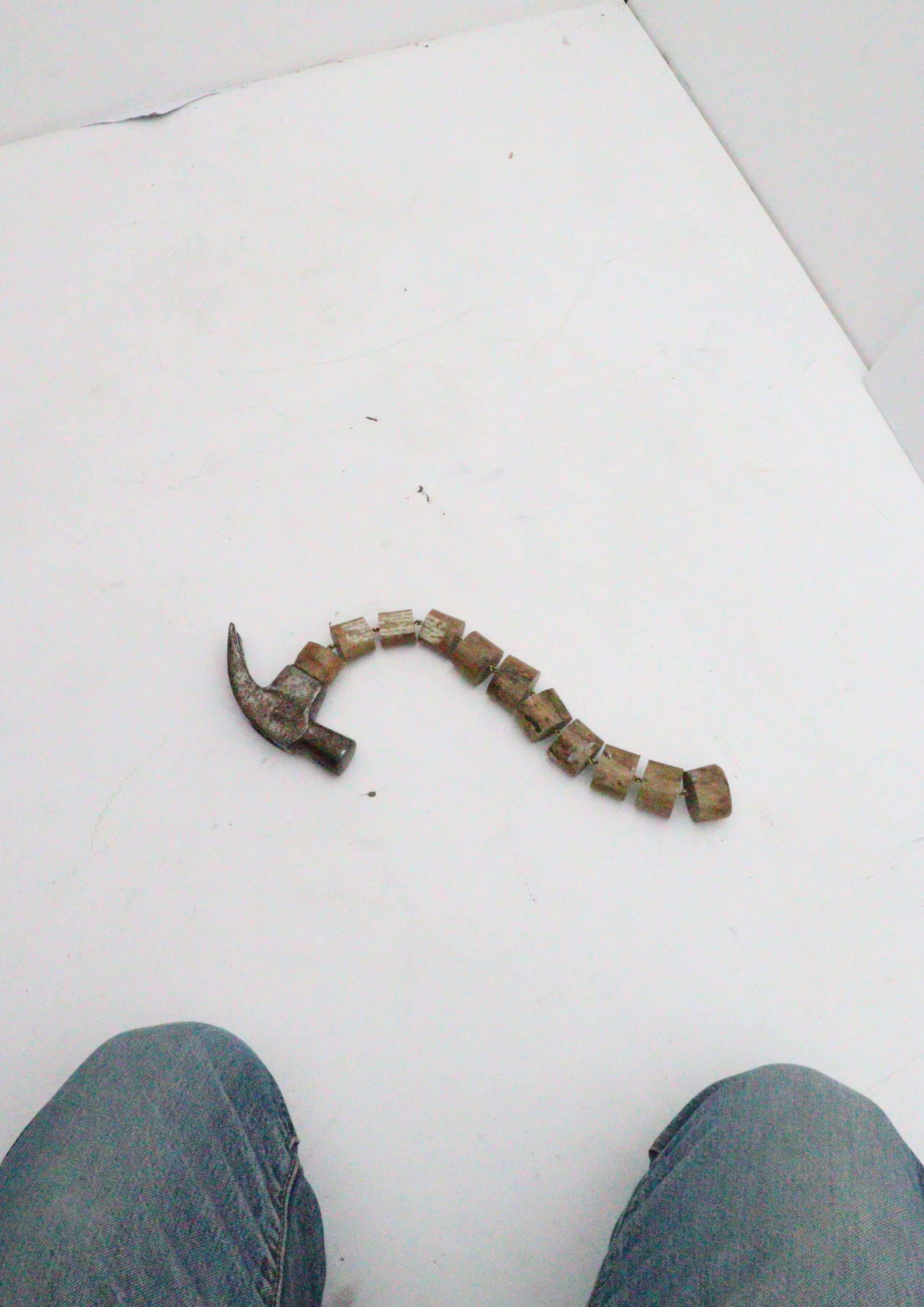
The hammer is a universally recognised and symbolically charged object: ubiquitous and familiar, associated with ideas of masculinity, violence, and repair. In Flaccid Hammer 2023 (fig. 1), Robinson engages with this collective understanding by preserving the hammer’s form, yet deliberately resists pointing to the obvious narratives it evokes. He simply withholds the object's function.
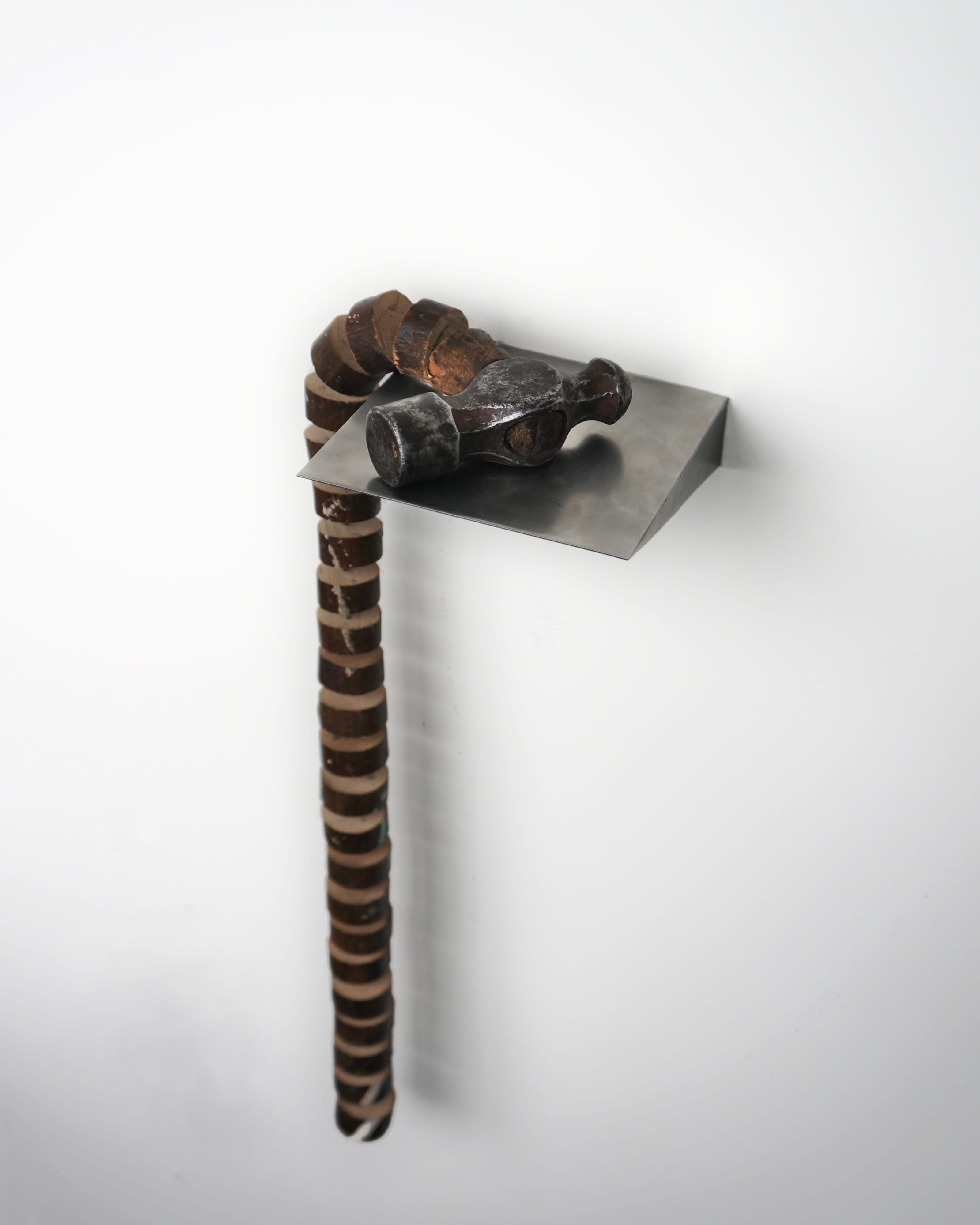
Through minimal intervention - slicing the handle into segments and linking them back together like a chain - he gently hints towards the language of jewellery. The result is unmistakably a hammer; however, not destroyed or radically transformed but rendered unusable and flexible. Through this, it resists categorisation and occupies a liminal state between the literal and the figurative, utility and decoration, sculpture and adornment (fig. 2).
By evading a conclusive reading, the work sustains multiplicity and creates a ‘silent’ space - one that is accessible and familiar, yet open - allowing viewers to engage with the work independently of the artist, and to think, feel, and understand it in their own way (Sontag, 2009a. pg. 14).The viewer is left to complete the work - not only perceptually but also conceptually.
Another added layer in Robinson’s practice is his quiet material strategy. Flaccid Hammer is not refinished or, in Sontag’s words, “carried to a point of final simplification” (Sontag, 2009b. pg. 7); rather, its original, found condition remains largely untouched. Signs of previous use and imperfections are left visible on its surface, as well as traces of faint pencil marks from the artist’s making process. Without polishing or sanding, the object's history gains significance and “[weighs] more”. Through restraint, the hammer reveals a past that cannot be fully accessed or interpreted - one that “continues speaking, but in a manner the audience can’t hear” (Sontag, 2009b. pg. 7).
This approach echoes Susan Sontag’s critique of over-identification between creator and creation: “Art becomes the enemy of the artist” (Sontag, 2009b. pg. 5). While Robinson is the current author of the piece, he does not impose control of its framing but instead adopts a soft and elusive stance. The hammer’s familiarity and prior use mean that authorship is always shared collectively and as Sontag highlights, “language points to its own transcendence in silence, silence always points to its own transcendence - to a speech beyond silence” (Sontag, 2009b. pg. 18) - an ongoing cycle where speech and silence alternate, with each viewer contributing new meaning. The piece itself manifests cultural production that is both collaborative and processual, rather than final and authoritative. Its silence becomes a generative space where meaning is continuously made and remade.
“As some people know now, there are ways of thinking that we don’t yet know about. that there are always ways of thinking that we don’t know about. Nothing could be more important or precious than that knowledge, however unborn.” (Sontag, 2009b. pg. 18). Within contemporary jewellery, this “unborn knowledge” is often understood as innovation in technique or original concept. While many people seek visual impact or semantic clarity, Sontag draws attention to one of art’s most progressive potentials: its ability to reveal or invent new ways of seeing.
These moments are not always immediately noticeable but they carry cumulative weight. Quiet strategies like that of Robinson’s are powerful because they invite uncertainty, multiplicity, and open dialogue. Meaning transforms - from one interpretation to the next - and it is within this space that the diversity of the jewellery field is honoured. In this light, jewellery has capacity to pass current frameworks of fixed interpretation and can become a medium of relational possibility.
Communication Continues when the breaks remain open
Patricia Domingues’s practice extends quiet dialogue into the social realm through activating relationships between the artist, the artwork, and consequently, the viewer and wearer. In contrast to the more large-scale or performative contexts commonly associated with Nicolas Bourriaud's theories on relational art, Domingues’ pieces enact ideas of relational aesthetics on an intimate level. They bring together silence as a space for interpretation and relationality as a structure for communal dialogical exchange.
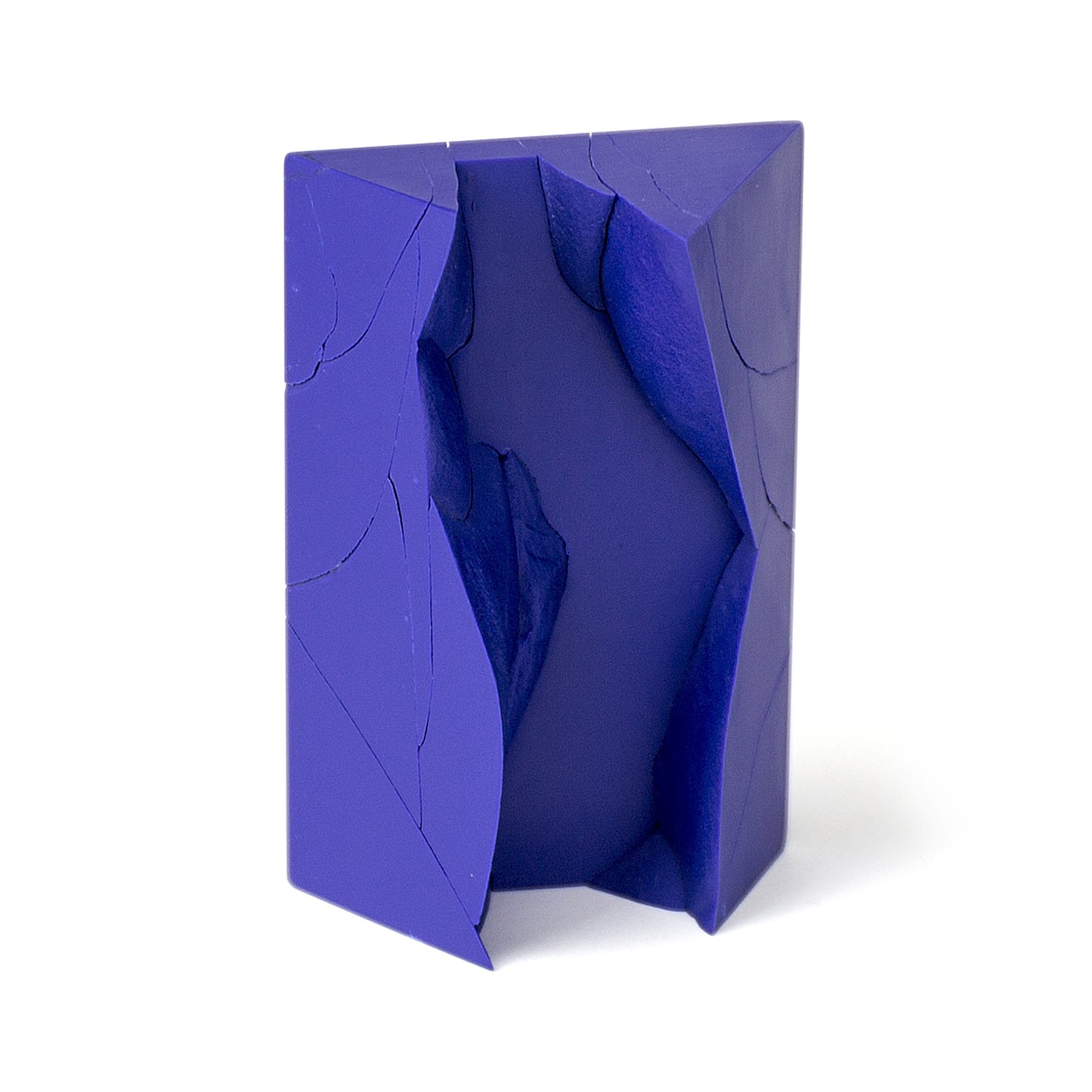
While Miles Robinson’s work embraces silence through restrained material intervention, Patricia Domingues’s jewellery (fig. 3), by contrast, positions direct material intervention as its strategy. Her pieces, composed of both natural and artificial gemstones, are often carved into simplistic forms and then deliberately broken using hammers and chisels - only to be reassembled through acts of repair (Altman, 2023). These actions leave noticeable cracks, fractures, and fusions that resist seamlessness, holding tension between control and chance. The break is never fully fixed but becomes the work itself.
Rather than offering autonomous meaning, Domingues’s pieces contain a relational quality that resonates with Bourriaud’s understanding of art as a “state of encounter” (Bourriaud, 2002. pg. 18). The pieces are not passive nor predetermined, but the result of reciprocal exchanges: the artist shapes the material, the material responds stating its own agency. They are made through a conversation between the artist and stone - a material negotiation of intention, accident and care.
This collaborative dynamic between maker and material has long been central to Domingues’s practice. Unpredictability is embraced through “a certain degree of randomness” - the pieces act as sites to facilitate experience rather than define it (Bourriaud, 2002. pg. 30). The artist sets the conditions for interaction but does not, and cannot control the outcome.
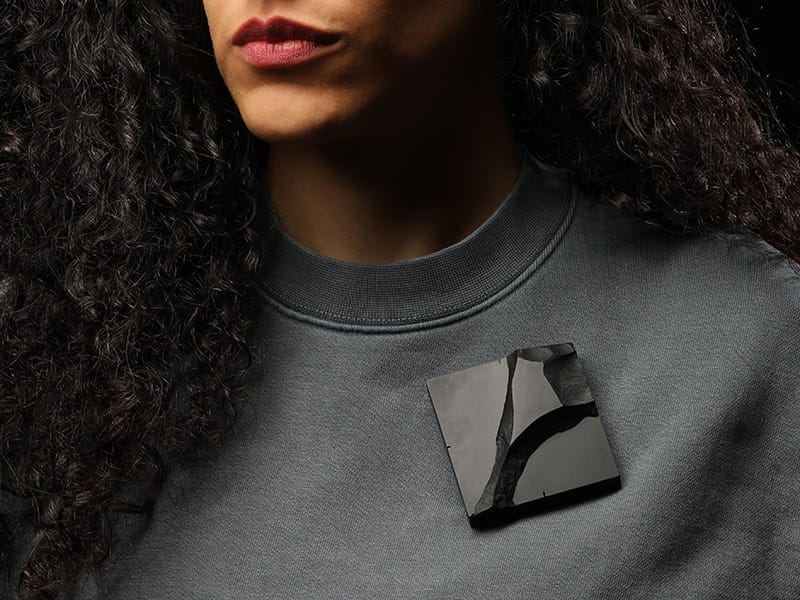
The visual breaks, gaps and lines in each piece create what Susan Sontag might call a “ruptured dialogue” (Sontag, 2009b. pg. 8) - a space of conceptual distance between the artist and her audience that invites reflection rather than instruction. Encounters unfold not only between artist and material, but also between viewer and object, the wearer and brooch (fig. 4). By exposing the process of making, Domingues resists traditional ideas of artistic authority - reframing the usually solitary act of creation as an open and mutual experience. As Bourriaud says, “in the spirit of transparency… the work shows or suggests not only its manufacturing and its production processes, [but] its position within the set of exchanges” (Bourriaud, 2002. pg. 41). The fractures are intended focal points, used as “a technique for focusing attention” (Sontag, 2009b, pg. 13), where the viewers are invited into her process - to notice the lineage of action, resistance, and response embedded in each piece.
The jewellery is not just materially ‘open’, but socially alive through becoming a “utopia” experienced “in the real time of concrete” and “intentionally fragmentary experiments” (Bourriaud, 2002, p. 45). Meaning is not extracted from the work like a coded message but emerges through shared encounter. Their full expressive potential is realised through the bodily awareness and mindfulness they invite - it is slowness, the intimacy of looking, touching, wearing, or imagining, that activates the work’s conceptual depth. The visible history, tactile surfaces and open-endedness enact what Sontag describes as “an erotics of art”: a way of engaging that privileges form, sensation, and presence over interpretation. How they are what they are - rather than what they mean (Sontag, 2009. pg. 13).
Within both gallery contexts and the intimate space of the body, Domingues’ methods remain both reflective and participatory. Her work operates within what Bourriaud calls “the interstice”: a gap in the expected order that opens space for ambiguity, and new forms of relation. They resist overt narrative or spectacle, instead offering moments of pause to recalibrate our relation to material, self, and social context. These interstitial gestures are not grand revolutionary acts, but quiet interruptions - small acts where art allows space for contemplation within the flow of the everyday (Bourriaud, 2002. pg. 16).
Building on this, Domingues’s practice does not close in on itself, but opens outward. Her work challenges conventional expectations of art jewellery by proposing a quieter form of resistance - one that neither fully rejects herself as the author, nor form or function, but reimagines them as fluid and relational. As Bourriaud notes, “relational art is not the revival of any movement... it arises from observation of the present and of a line of thinking about the fate of artistic activity” (Bourriaud, 2002. pg. 25). Domingues’s work participates in this future-oriented stance - through structures of openness and uncertainty, where fragmentation and attentiveness become strategies for engagement. These are not objects that dictate meaning, but material propositions that hold space for response.
A Space Beyond Silence
Across this essay, I have argued that silence - understood not as a void of meaning but as a deliberate aesthetic strategy of openness, ambiguity, and resistance - invites a much-needed rethinking of authorship and meaning in contemporary jewellery. Drawing from the theories of Roland Barthes, Susan Sontag, and Nicolas Bourriaud, and through the practices of Miles Robinson and Patricia Domingues, I have explored how jewellery can communicate not through what it declares, but through what it withholds. Whether through Robinson’s restrained gestures or Domingues’s fractured and relational forms, both artists resist conceptual over-definition and cultivate spaces of uncertainty, reflection, and shared meaning.
These works challenge the institutional pressure to prioritise a singular authorial voice. Instead, they open space for the viewer, wearer, and object to co-participate in meaning-making, redistributing creative agency and inviting a slower, more affective engagement. Silence becomes a site of potential - an invitation to pause, to notice, and to attend to what is not immediately articulated. Jewellery shifts from being a vehicle for declarative identity to becoming a site of relational, reflective encounter.
We should focus less on the content that jewellery communicates, and more on its ability to move beyond fixed interpretive frameworks - toward a model that embraces multiplicity, ambiguity, and unfolding meaning. Such a model is not only more aligned with the heterogeneous and shifting nature of contemporary jewellery, but also with the unique communicative qualities of jewellery itself: an inherently silent form, operating before speech and after silence, proliferating through gesture, proximity, and presence.
Perhaps, then, the future of the discipline does not rest solely in producing works that are more open-ended, but in reconsidering the frameworks through which we encounter and engage with them. In practical terms, this may mean rethinking curatorial and educational approaches. Gallery contexts, for instance, might mirror the diversity and complexity of the field not only through curated works but through the design of the viewing environment itself - spaces that cultivate intimacy, slowness, and reflection. This could involve centering the artist’s process, facilitating artist-led discussions, and developing interpretive materials, such as wall texts or exhibition writing, that encourage open-ended reflection rather than assert singular readings. Contexts where making, discussing, and wearing intersect can also become key platforms for cultivating attentiveness.
As Sontag said one of art’s most progressive potentials is its ability to reveal or invent new ways of seeing. Ultimately, embracing silence as methodology calls for deeper forms of attention - gestures that speak softly, linger longer, and open plural modes of being with and through the work. In a time increasingly saturated with spectacle, it may be the quietest pieces - the ones that wait rather than speak - that carry the most radical potential. As much as they resist the demand to explain, they open space for us to feel, to reflect, and to listen - to move, perhaps, to a space beyond silence.
Bibliography
Altmann, J. (2023). ‘Lines and Fractures’ in Art Jewellery Forum. [Online]. Available from: https://artjewelryforum.org/interviews/maker-patricia-domingues_natl-portugal_writer-jen-altmann_natl-us_8-21-2023/. (Accessed: 05 June 2025).
Barthes, R. (1977). ‘The Death of the Author’ in Image-Music-Text. Translated by S. Heath. New York: Hill and Wang, pp.146-148.
Bourriaud, N. (2002). Relational Aesthetics (originally published 1998), Dijon: Les presses du réel. pp. 16-45.
den Besten, L. (2012). On jewellery: a compendium of international contemporary art jewellery, Stuttgart: Arnoldsche art publishers. pp. 10-11.
Sontag, S. (2009a). Against Interpretation (originally published 1964), London: Penguin Books Ltd. pp. 12-14.
Sontag, S. (2009b). Styles of Radical Will (originally published 1966), London: Penguin Books Ltd. pp. 5-18.
Unger, M & van Leeuwen, S. (2017) Jewellery Matters, Rotterdam: nai010 publishers. pg. 11.
Image List
Figure 1. Robinson, M. (2023) Flaccid Hammer. [Photograph]. Provided by the artist, personal communication, 10 July 2025.
Figure 2. Robinson, M. (2023) Flaccid Hammer. [Photograph]. Provided by the artist, personal communication, 10 July 2025.
Figure 3. Domíngues, P. (2017) Imagined Erosion Series. [Photograph] Available at: https://theroom.loewe.com/en/artwork/patricia-domingues/imagined-erosion-series-1 (Accessed: 26 June 2025).
Figure 4. Domingues, P. (2023) Patricia Domingues Brooch. Art Jewelry Forum. [Photograph] Available at: https://artjewelryforum.org/interviews/maker-patricia-domingues_natl-portugal_writer-jen-altmann_natl-us_8-21-2023/ (Accessed 18 July 2025).
For the original essay document please refer to the following link:
https://drive.google.com/file/d/1LY6Mg_95AfPqECQpTufQ0q_5WpqdfeAu/