Annarita Bianco
Morphosis: Matter Beyond Geometric Abstraction and Fractal Nature in Contemporary Jewellery
CV
Annarita Bianco - Short CV
Annarita Bianco is a designer and silversmith, founder of Merıstėma Lab, an experimental design studio that adopts a Research through Design approach. She strives to push beyond conventional defi nitions of jewellery, crafting symbolic objects that provoke refl ection on urgent global issues.
She is pursuing a PhD in Design for Made in Italy at the University of Campania “Luigi Vanvitelli,” where her research centres on developing jewellery and wearables for interspecies care. She is also a lecturer in Eco-Product Design and Fashion Design courses at the Department of Architecture and Design.
Abstract
Morphosis: Matter Beyond Geometric Abstraction and Fractal Nature in Contemporary Jewellery - Abstract
This paper investigates the active role of matter in contemporary jewellery design, weaving together critical theory and hands-on experimentation. Beginning with a critique of the mechanistic view of matter as passive and inert, it explores three pivotal shifts in Western thought concerning morphogenesis—understood as the process by which matter organises and takes form: the geometric paradigm of crystalline thinking, the emergence of complexity through fractal geometry, and the relational approach developed by new materialist philosophy. Given its intrinsic connection to materiality, jewellery is presented here as a critical device capable of activating new relationships between human, matter, and technology, while promoting a vision of design as a situated and co-creative practice. The capsule collection Morphosis, discussed in this paper, explores these ideas through experimental practice, demonstrating how knowledge can emerge through making. The design process, combining fractal generative software and electroforming, yields not fi nalised objects, but emergent forms—products of co-evolutionary interactions that recognise matter as an active participant in transformative processes.
Keywords:
Contemporary Jewellery, Material Agency, Morphogenesis, Electroforming, Fractal geometry
Text
Morphosis: Matter Beyond Geometric Abstraction and Fractal Nature in Contemporary Jewellery
Introduction: A Genealogy of Matter in Western Thought
Western philosophy has traditionally conceived matter as a passive substance, lacking autonomy: from the Platonic and Stoic schools to mechanistic and Cartesian thought, matter has been regarded as inert—and, by extension, reality itself interpreted as something objective and preconstituted. This perspective, reinforced in the nineteenth century by positivism, has long framed matter as something to be “observed, analysed, and manipulated,” in contrast with a “subject who knows and acts” (Fiorani, 2000, p. 13). Within this oppositional framework of subject/object and observer/observed, passive matter became the substrate for intervention—analysis, study, and the appropriation of the laws governing its behavior: a deeply anthropocentric approach that is now being challenged by critical posthumanist and new materialist thought, which aim to deconstruct the binary foundations of centuries of Western philosophy (Ferrando, 2019, p. 107).
Due to its close engagement with materiality and transformation processes, contemporary jewellery is uniquely positioned to confront these philosophical questions both theoretically and practically. This paper explores how material agency can be meaningfully integrated into the design of contemporary jewellery, foregrounding processes of co-creation and becoming-with (Haraway, 2016). It begins by tracing the evolution of Western thought on matter through three key paradigmatic shifts: from the geometric regularity of "crystalline thinking," to the disruption of Euclidean order with fractal geometry, and fi nally to the relational, post-anthropocentric vision of new materialism. These paradigms are not presented as abstract theories alone; they are embodied in the process of designing and making jewellery, here understood as a “thinking device” (Scarpitti, 2020)—an artefact capable of refl ecting on and challenging the relationships between matter, form, and multiple subjectivities. The case study Morphosis, presented in the second half of the paper, exemplifi es these ideas in practice, and the paper concludes with a refl ection on the transformative potential of a design approach that recognises matter as an active, co-creative force.
Morphogenesis: The rigour of crystalline thinking
Matter is organised in space and time according to evolutionary patterns known as morphogenesis—a process in which form and substance are confi gured as complementary and inseparable aspects (Tripaldi, 2023). In the 17th century, with René Descartes’ introduction of the concept of scientifi c objectivity, geometry and mathematics became privileged tools for interpreting reality, helping to shape the Weltanschauung of the time. Morphogenesis was investigated by various scholars, most notably Niels Stensen, who in 1669 formulated the law of the constancy of dihedral angles in crystalline formations. Stensen observed that, while crystals may vary in shape and size during growth, they always retain the same internal angular relationships between their faces. His fi ndings contributed to a vision of nature grounded in geometric regularity, inspiring an aesthetic of matter in which the crystal—as a polyhedron—became a symbol of rigour and rationality. Within this historical and conceptual framework, "crystalline thinking” emerges: a convergence of aesthetics, science, economics, and politics based on the belief that the internal structure of matter—and nature as a whole—follows ordered geometric principles. Moreover, it asserts that the human intellect, as part of nature,
shares in this same logical-organisational framework (Lindemann & Smeets, 2020, pp. 76–77).
Crystalline thinking remained dominant until the 19th century, when chemistry began to explore the origins of life from inert matter. At the time, crystals were the only examples of growth processes that could be reliably reproduced in a laboratory setting. However, unlike complex organisms, the growth of crystals depended solely on external factors—such as deposition and chemical composition—following predictable trajectories (Tripaldi, 2022, p. 152). This distinction between biological complexity and the controlled reproduction of crystal forms would lay the groundwork for a new paradigm that could engage with disorder, irregularity, and non-linearity.
Fractal matter: dealing with complexity.
As scientific and philosophical reflection advanced—alongside new observational technologies—a new way of understanding form emerged, one capable of embracing elements that had previously remained at the margins of geometric description. Matter does not always conform to linear or stable logics: the need to comprehend the irregular, the discontinuous, and the formless arose alongside crystalline perfection. In this transition—from order to complexity—new modes of thought began to take shape, enabling a deeper engagement with the ambiguities of the natural world.
As early as 1936, Paul Valéry poetically anticipated this shift, writing: “I sometimes thought of the formless. There are things—stains, masses, contours, volumes—that, in some way, exist only as facts: they are merely perceived by us, but not known” (1965, p. 1194). However, it was only several decades later that mathematics developed the tools necessary to grapple with the complexity of such forms. With fractal geometry, Benoît Mandelbrot introduced a new mathematical language capable of describing the irregularity and apparent chaos of natural forms: “Clouds are not spheres, mountains are not cones, coastlines are not circles, and bark is not smooth, nor does lightning travel in a straight line” (Mandelbrot, 1983, p. 2).
This represents an interpretation and reworking of natural logic made possible by the rise of computing technologies from the 1970s onward—technologies that “permit us to recognise and reproduce in fractals the logical vortices of nature’s elementary phenomena” (Branzi, 2004, p. 19). Fractals, as iterative models that capture the deep structure of natural elements, signal a shift from crystalline thinking to a thinking of the formless—one that acknowledges form even where no clear principle of regularity is readily apparent. By mirroring the complexity of nature, fractals challenge the presumed infallibility of traditional scientifi c methods, restoring to science a degree of “viscosity and friction” derived from the real world. The concept of fuzzy thinking emerges, which, by moving away from the rigidity of mathematical formalism, charts a path through methodological crisis toward a new naturalism (Kosko, 1993).
Relational Matter: New Materialism and Agency.
A true methodological rupture emerged in the early twentieth century, when Niels Bohr’s quantum model of the atom revolutionised the philosophy of science. Matter was no longer seen as passive and stable, but as a co-agent in processes of knowledge and transformation. Moreover, Heisenberg’s uncertainty principle eliminated the possibility of a rigid dualism between subject and object, presenting them as relational and mutually constituted entities (Ferrando, 2019, p. 168). In quantum mechanics, every observation alters the observed system, making the observer an integral part of the phenomenon: “nothing can be measured or observed without being disturbed” (Rae, 1986, p. 3).
From this perspective, knowledge is not a neutral refl ection of reality, however the result of continuous interaction between observer, instruments, and matter—an experience “entangled with our tools and the materials we use” (Tripaldi, 2019, p. 209), unfolding through “interferences” and “intra-actions” (Barad, 2007, p. 52). Consequently, the knowledge of reality and reality itself is no longer assumed to be objective and autonomous—it emerges through dynamic processes. Matter is reconceived as a “quasi-subject” (Latour, 2020), endowed with its agency and engaged in shared action with other hybrid and co-determined entities.
There are no pre-existing objects, only “phenomena—reconfi gurations, linkages, relationalities, and rearticulations” (Barad, 2007, p. 141). As Latour notes, “to be a subject is not to act autonomously in front of an objective background, but to share agency with other subjects that have also lost their autonomy” (Latour, 2014, p. 5). The performative new materialism of Karen Barad and the vitalist perspective of Jane Bennett reinterpret this principle through a post-anthropocentric lens, articulating a new vision of matter—and of the universe itself—in which no entity-object is conceived as neutral material for analysis, but rather as the outcome of relationships that generate both form and meaning.
Morphosis: Thinking through Matter.
Once the notion of matter as an inert and passive medium is set aside, the design process can no longer be understood as an act of unilateral control: it becomes a co-evolutionary and relational process in which humans, technology, and material intra-act, mutually infl uencing one another. When applied to contemporary jewellery, the neo-materialist approach opens up a practice where the relationship with matter does not result in an artefact defi ned by a fi xed fi nal form, but rather by an open-ended and situated process. Fabrication techniques are no longer limited to mechanical operations; they now involve transdisciplinary approaches integrating mechanics, biology, electronics, and emerging digital technologies.
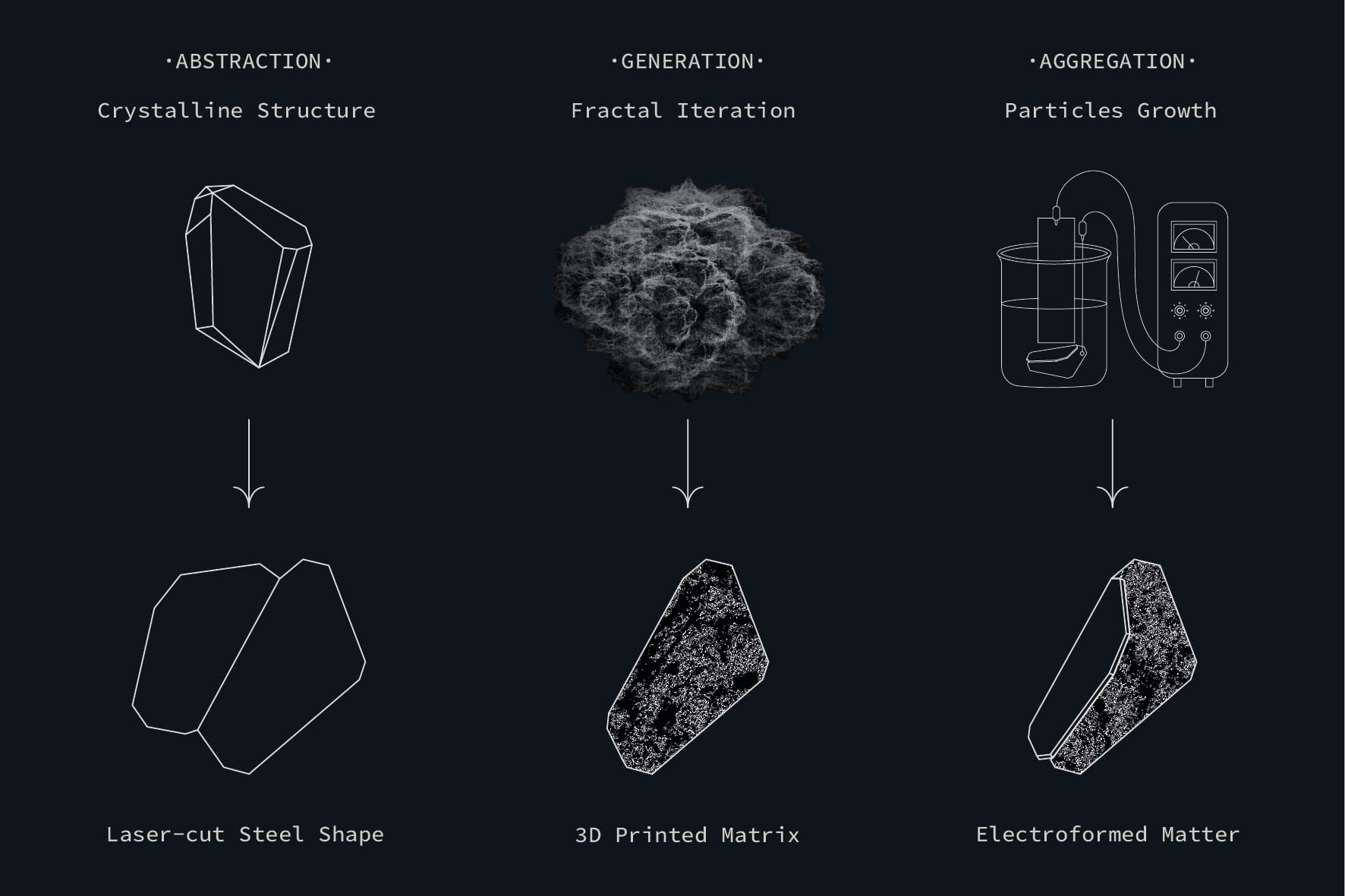
The Morphosis project is rooted in an experimental approach that aims to traverse and interweave the three evolutionary stages of the dialectical relationship with matter described in the previous section. This approach is articulated through conceptual and technical operations culminating in jewellery creation [img. 1]. The fi rst stage is based on geometric abstraction inspired by the crystalline structures of minerals, referencing the three primary crystal systems: isometric, tetragonal, and orthorhombic. The two-dimensional forms, derived from historical mineralogy texts, were fabricated in mirror-polished stainless steel using high-precision laser cutting.
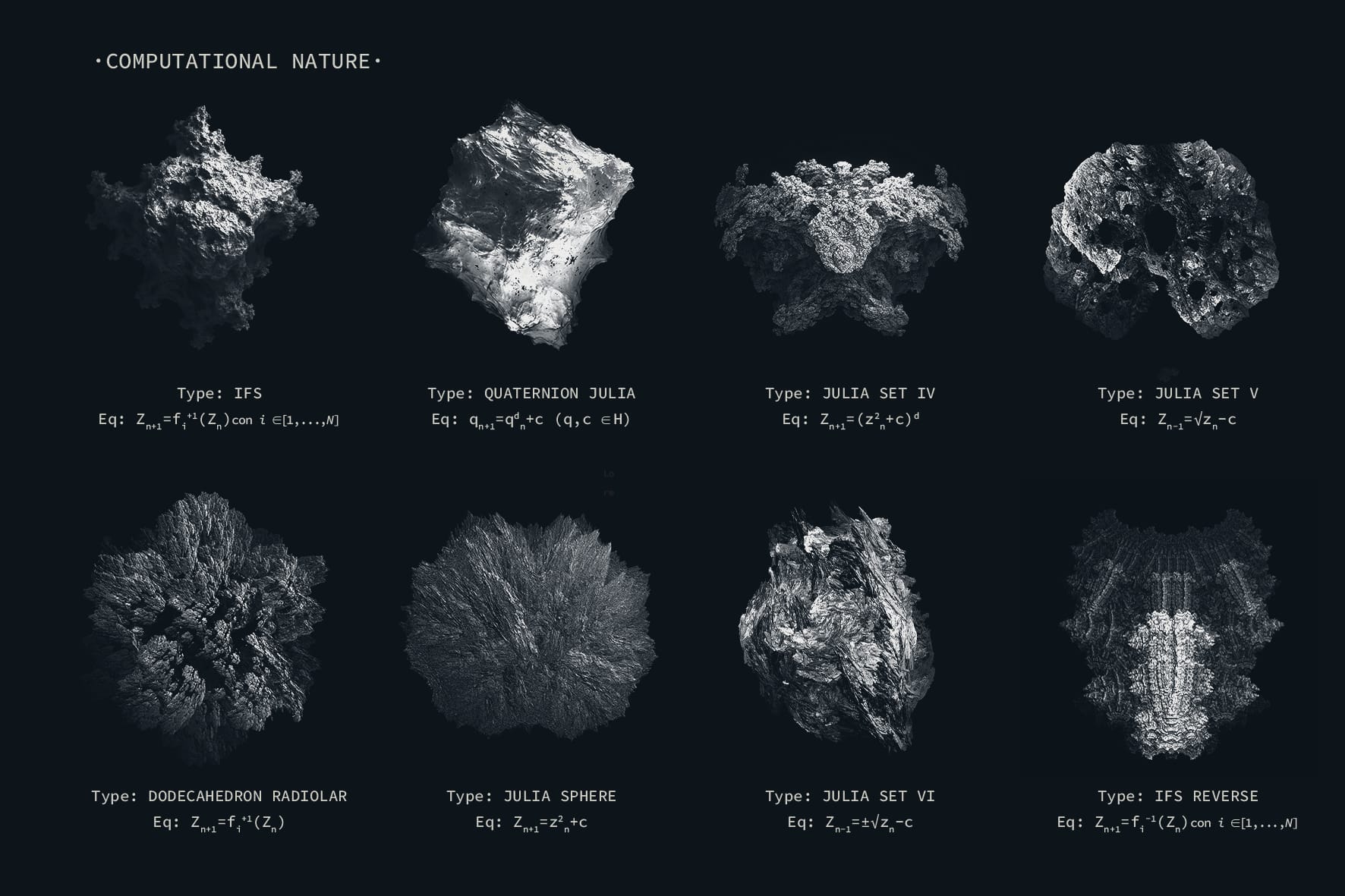
The second phase involved Mandelbulb 3D (MB3D), an open-source fractal modelling software capable of generating complex three-dimensional geometries through dozens of nonlinear equations, specifi cally, iterations of the “Julia set” were explored [img. 2]. The digitally generated fractal structures were exported as meshes; specifi c fragments were extracted, modifi ed, and optimised for 3D printing; the resulting models were printed in PLA using FDM technology and coated with conductive paint to prepare them for the subsequent electroforming process.
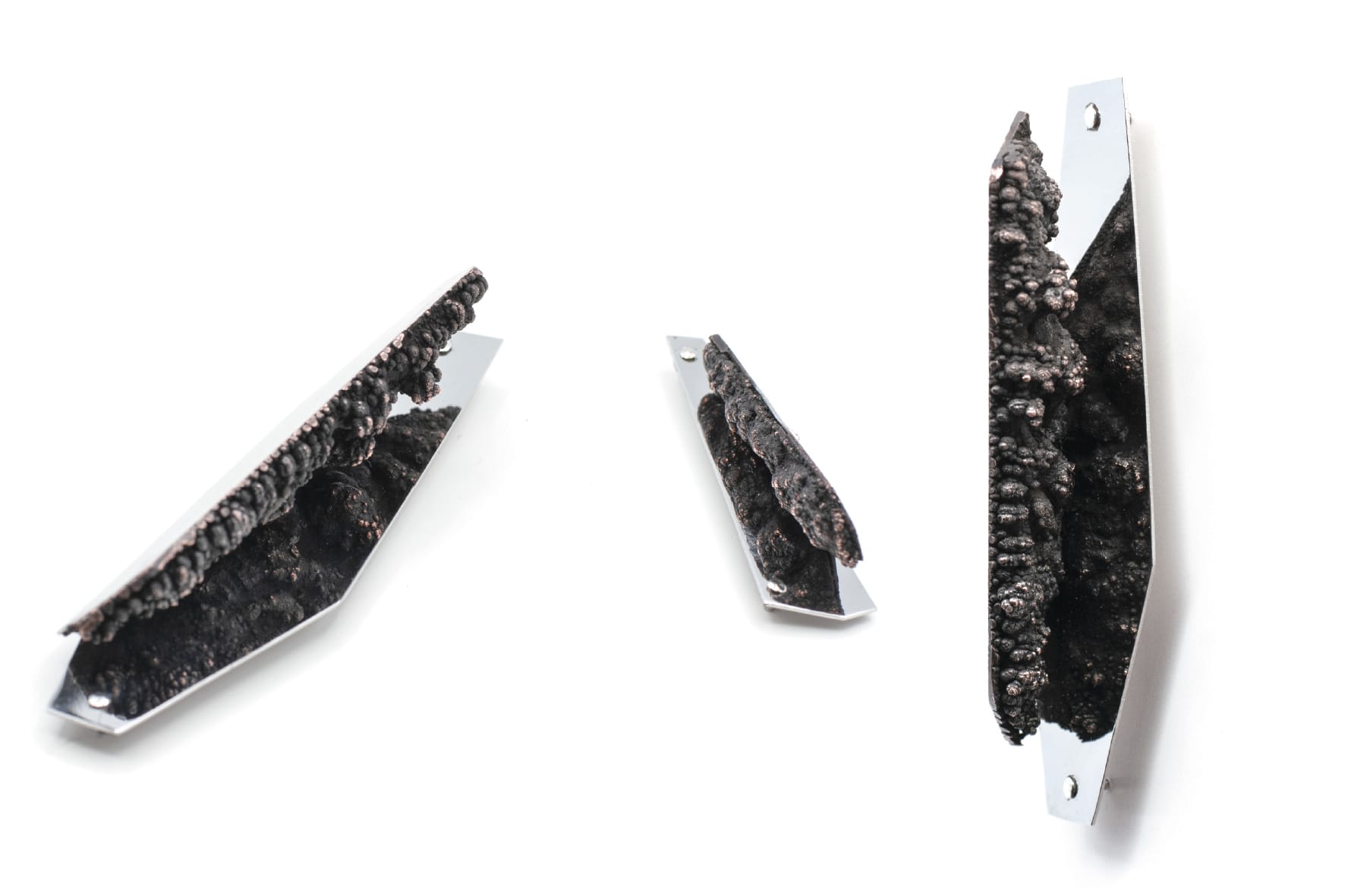
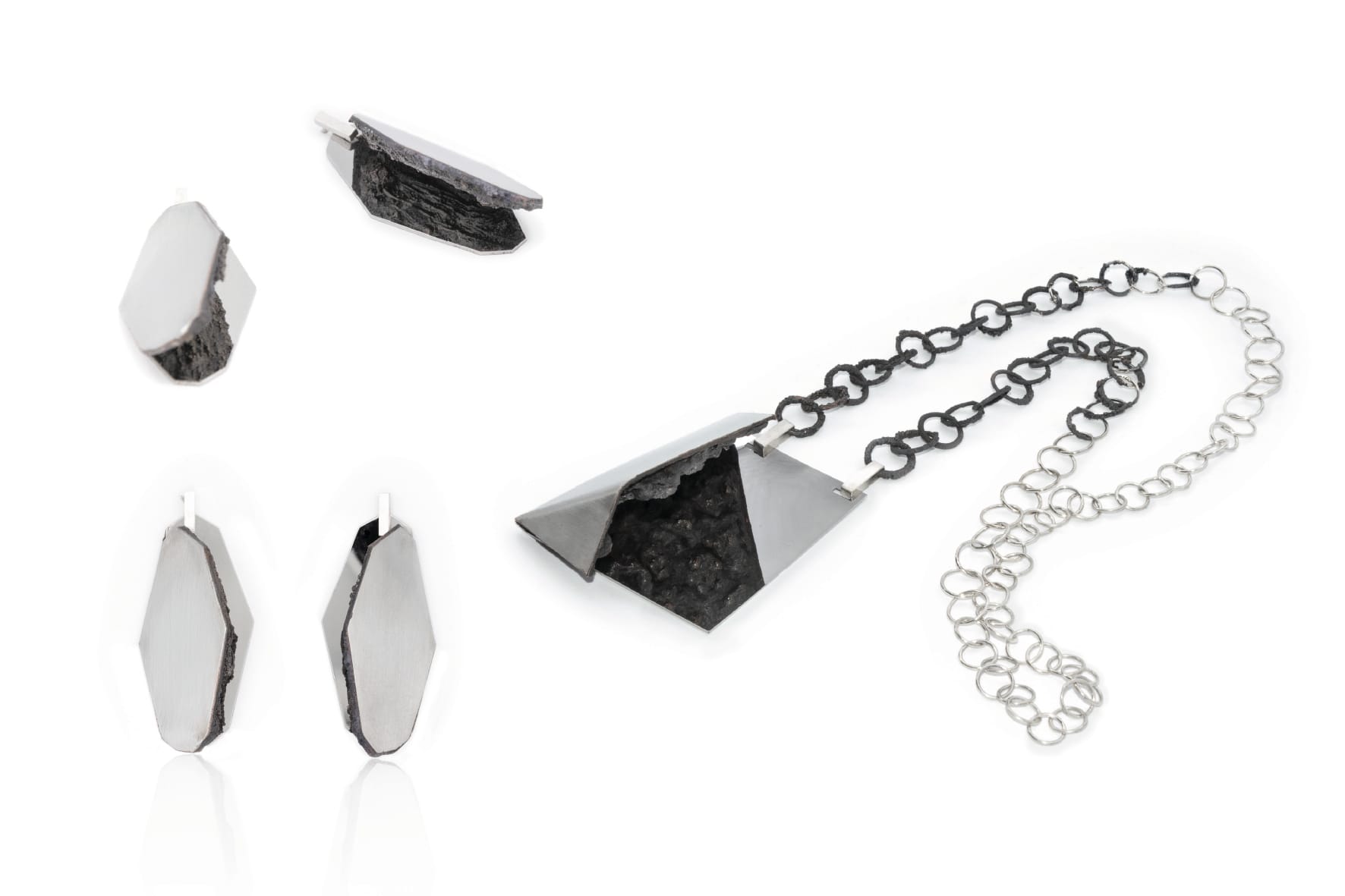
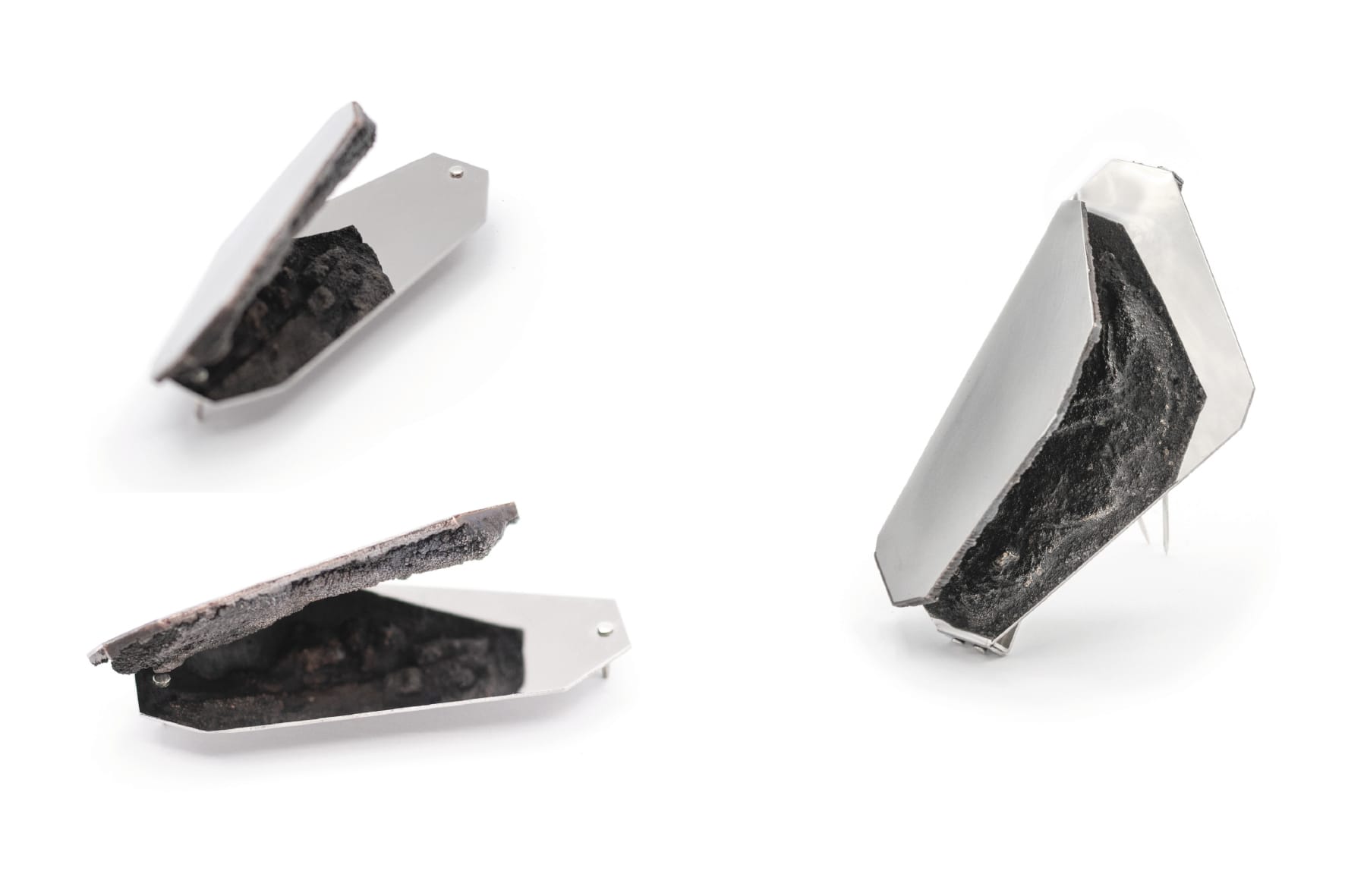
In this third phase, the algorithmically generated matrix was assembled with the steel structure using two pins, coated with conductive paint and subjected to galvanic electroforming. This electrochemical technique deposits layers of pure metal (such as copper, silver, or gold) onto a conductive substrate. In this case, the model was immersed in a copper sulfate solution, connected to a direct current power supply's negative terminal (cathode). A pure copper anode, connected to the positive terminal, released metal ions that migrated through the solution and deposited onto the model's surface. Controlled modulation of voltage, amperage, and deposition times enabled uneven material growth, which reshaped and transformed the original fractal geometry. This recursive growth process produced irregular and varied structures, resulting in unpredictable formal outcomes and an emerging aesthetic that directly connects natural growth patterns and those of computational origin. The pieces were then finished by applying a black patina to the electroformed areas, creating a collection of brooches, pendants, and earrings [img. 3, 4, 5].
The resulting forms fold inward, accentuating the contrast between geometric rigour and chaotic expansion — a cryptic nature, concealed at fi rst glance, revealed only through its mirrored refl ection. In this play of refl ections, subject and object, observer and observed, merge and blur, ultimately dismantling the dualisms of modern thought.
Towards a Situated and Relational Design Practice.
The design approach presented in this case study seeks to acknowledge the transformative capacity of matter by adopting design practices that are not extractive but dialogical, where even the most inconspicuous elements play an active role in shaping form (Blank, 2024). Jewellery becomes a site of relationship between diff erent species and systems (Blank, 2023), assuming aesthetic value and the capacity to construct meaning. Thus, designing means situating oneself within a relational environment, while recognising the partiality and co-responsibility of one’s actions.
In this context, techniques such as electroforming—which involve direct engagement with chemical reactions, growth, and transformation—or generative software become practices of listening and co-production, rather than formal imposition.
Adopting a neo-materialist approach to contemporary jewellery means remaining anchored in its defi ning feature—the capacity to engage with the present and its cultural, social, and political urgencies. Its value lies in its ability to materialise contemporary “thoughts, refl ections, provocations, and states of mind,” becoming a sensitive expression of the zeitgeist (Bergesio, 2008, p. 17). Each artefact represents a renewed response to the question: “How does contemporary thinking in other disciplines help us to rethink the fi eld of contemporary jewellery?” (Skinner, 2013, p. 187).
References
Barad, K. (2007). Meeting the universe halfway: Quantum physics and the entanglement of matter and meaning. Duke University Press.
Bennett, J. (2010). Vibrant matter: A political ecology of things. Duke University Press.
Bergesio, M. (2009). Timetales. Time’s percerptions in research jewellery. Grupo Duplex.
Branzi, A. (2006). Weak and diff use modernity: The world of projects at the beginning of the 21st century. Skira.
Fiorani, E. (2000). Leggere i materiali: Con l'antropologia, con la semiotica. Lupetti.
Ferrando, F. (2019). Philosophical Posthumanism. Bloomsbury Academic.
Haraway, D. J. (2016). Staying with the trouble: Making kin in the Chthulucene. Duke University Press.
Latour, B. (2014). Agency at the time of the Anthropocene. New Literary History, 45(1), 1–18.
Lindemann, W., & Smeets, T. (Eds.). (2000). Thinking jewellery II. Arnolsche Art Publishers.
Mandelbrot, B. B. (1982). The fractal geometry of nature [Original work published 1975]. W. H. Freeman.
Rae, A. I. M. (1986). Quantum physics: Illusion or reality? Cambridge University Press.
Skinner, D. (2013). Contemporary jewelry in perspective. Lark Jewelry & Beading.
Tripaldi, L. (2022). Parallel minds: Discovering the intelligence of materials. Urbanomic / Sequence Press.
Valéry, P. (1965). Del suolo e dell’informe. In Degas Danse Dessin, OEuvres. Gallimard.
Image captions
Img 1: The diagram illustrates the process behind creating the contemporary jewellery series Morphosis: geometric abstraction, fractal generation, and dendritic particle aggregation.
Img 2: A selection of fractal generation tests using the software MB3D, using diff erent iterations: computational nature reconstructs and reinterprets complex forms.
Img 3, 4, 5: Pendants, brooches and earrings from the Morphosis capsule collection. Materials: Silver, Stainless Steel, PLA, Electroformed Copper, Patina.
For the original essay document please refer to the following link:
https://drive.google.com/file/d/1nxAWYrEdk5gouqJRUlvmOpWXWFdKePsi/