
Jivan Astfalck
Material Semiotics in Contemporary Jewellery - Wearing Meaning
CV
Jivan Astfalck - Short Bio
Jivan Astfalck is a visual artist, jeweller and academic. Born in Berlin, where she trained as a goldsmith, she has been living in London for more than 40 years, returning to Berlin regularly.
She earned her PhD in Fine Art at the University of the Arts London and is now Professor Emeritus at Birmingham City University (BCU), where she previously taught at the world-renowned School of Jewellery. She is a Visiting Professor at the Sichuan Fine Art Institute in Chongqing, alongside numerous other teaching and consulting projects in China.
Prof. Astfalck combines her studio practice, which she exhibits internationally, with creative development and management of projects like Polyphonous, Whispers&Cries, and kittenhair.
Her focus and research interests are in using hermeneutic philosophy, literary theory, and other appropriate thought models as tools to investigate narrative structures embedded in
body-related craft objects. In her view, the convergence of crafts, design and fine art practices is conducive to extending the theoretical vocabulary and mapping out new territories where crafts practices contribute to cultural production and dissemination.
“Jewellery for me is unique expression of embedded and g(c)rafted narrative, intimately related to the body - both, sensually and intellectually.”
Abstract
Material Semiotics in Contemporary Jewellery - Wearing Meaning
Abstract
This essay examines the role of material semiotics in contemporary jewellery design, with an emphasis on narrative jewellery practices. Material semiotics refers to how materials operate as signifying agents within cultural, aesthetic, and socio-political contexts. Rather than being passive carriers of form or value, it extends the idea that materials in contemporary jewellery are active participants in meaning-making. This essay demonstrates how materials signify affect, memory, ethics, and identity within a discursive and embodied framework.
Drawing from post-structuralist, anthropological, and hermeneutic theory, in particular the work of Roland Barthes, Umberto Eco, Bruno Latour, Jean Baudrillard, and Karen Barad, this essay traces the transition from modernist ideals of material purity to a postmodern emphasis on interpretation and political critique. Jewellery is no longer seen solely as a luxury object but as a critical form of material writing. Artists interested in these dimensions of art practice use unconventional and often ephemeral materials like felt, ash, plastic, digital components, fount materials or objects to construct narrative and wearable artefacts that engage themes of trauma, displacement, ecological awareness, social resistance, utopian ideals, and the impact of globalised culture and identity.
This paper argues that contemporary jewellery, particularly in narrative forms, functions as an open text. Through interaction with the body, context, and memory, jewellery invites affective and interpretive engagement. Material here is not merely substance, it is epistemological and ethical. By examining the interplay between material, meaning, and wearer, the essay foregrounds the ways jewellery becomes a site of critique, intimacy, and political expression. Ultimately, material semiotics allow us to read jewellery not only through its formal characteristics but as an active cultural artefact embedded within complex systems of signification.
Keywords
• Material semiotics
• Narrative jewellery
• Material culture
• Emotional investment
• Hermeneutics
Text
Material Semiotics in Contemporary Jewellery - Wearing Meaning
Introduction
Jewellery has long operated at the nexus of material value, identity, and social signification. Yet from the 1980s onward, contemporary jewellery practices shifted from decorative convention to embrace critique, narration, and conceptual exploration. Material semiotics emerged as a critical lens through which materials are not inert but active carriers of meaning. Here, the jewellery object functions as a semiotic device that embodies cultural memory, bodily presence, and socio-political commentary. Rather than seeking purity or preciousness, artists began to interrogate the cultural codes embedded within material. In this context, jewellery ceased to be a static artefact and instead became a dialogical form of embodied knowledge. This essay situates contemporary jewellery within the frameworks of semiotic theory and hermeneutics, asserting that materials speak and act through a matrix of social, psychological, and corporeal entanglements.
From Modernist 'Truth to Materials' to Postmodern Semiotic Play
The late 20th century witnessed a cultural pivot. Theorists such as Roland Barthes (1972) radically challenged the idea that any material could be innocent or purely functional. In Mythologies, Barthes demonstrated that even the most banal objects carry layered cultural connotations. Materials became semiotic elements, capable of constructing conceptual messages. This marked the transition into postmodern design thinking, where materials were deliberately manipulated to evoke irony, critique, or narrative dissonance. In this context, Jean Baudrillard’s (1996) The System of Objects extended the argument, positing that commodities, including jewellery, do not simply satisfy needs but operate as signs within systems of cultural exchange. Jewellery made from plastic, for example, might signify anti-elitism, or kitsch nostalgia, or even rebellion, depending on its context. Value no longer resided in rarity or cost, but in signification. This disrupted traditional hierarchies in jewellery design and opened new expressive possibilities.
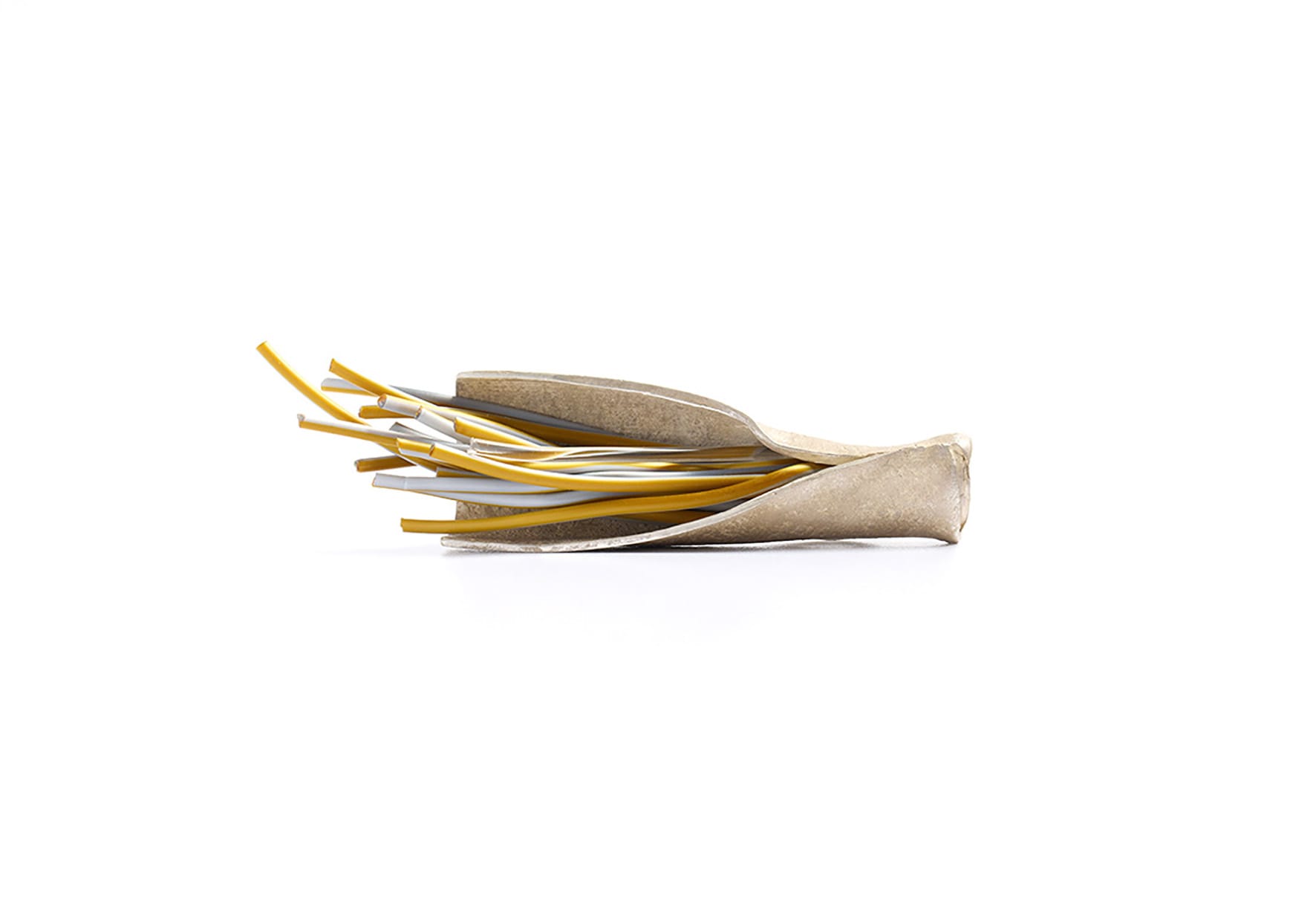
Compositions, constructed from synthetic foam, plastic junk, toys, felt, and other ‘rubbish’, are consciously questioning beauty in conventional terms. Yet they challenge the viewer to question what is considered wearable, valuable, or meaningful. By refusing refinement and embracing chaos, a semiotic inversion is performed: waste becomes signifier of critique, humour displaces reverence. This kind of work explicitly destabilizes the category of jewellery, insisting that significance is constructed, not inherent.
Fig.1
Rachel Darbourne - Was Hippo, from the ongoing series lovingly murdered
Fig.2
Timothy Information Limited - A sundial on a bit of string neck thing (No 6)
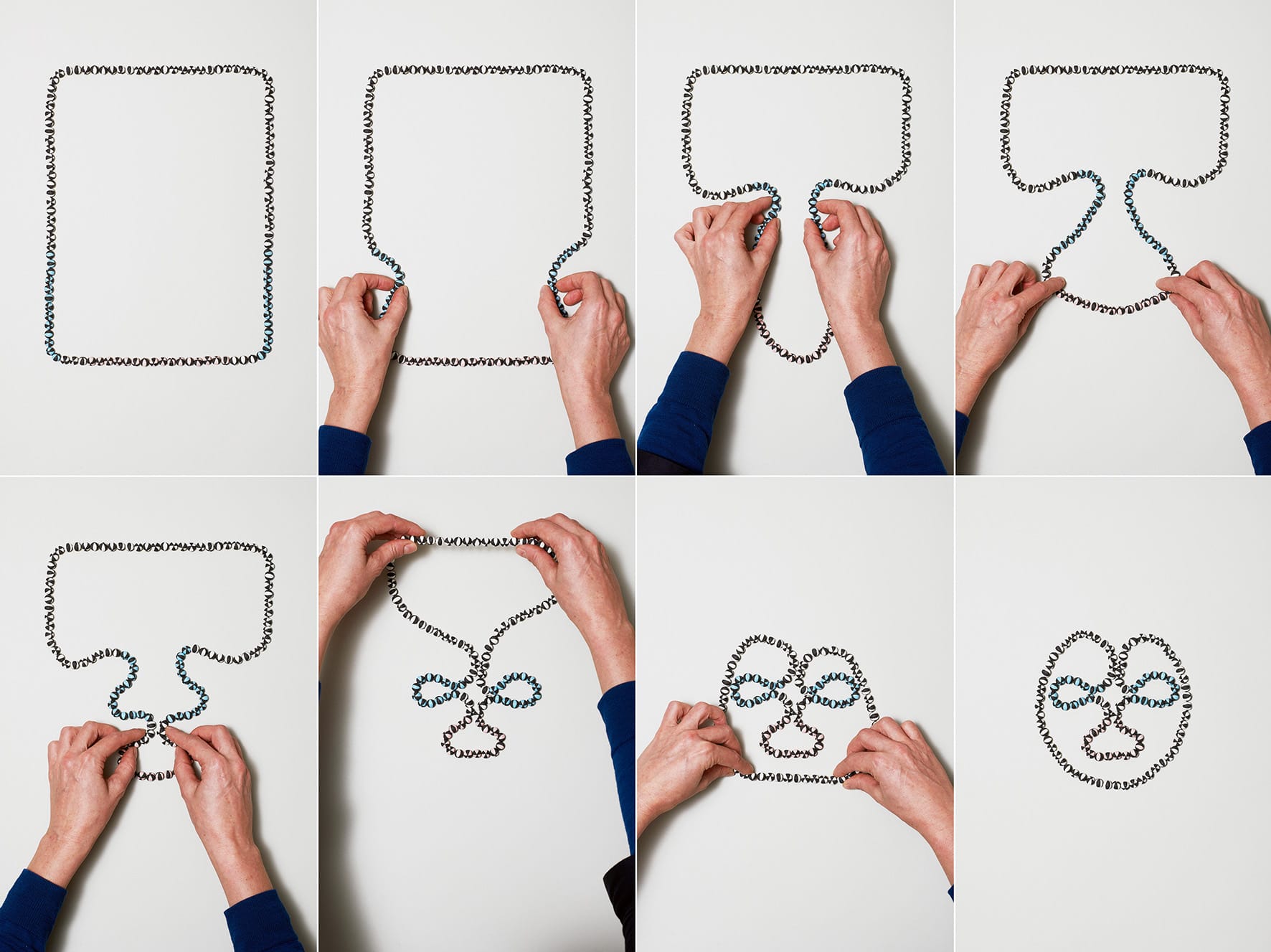
This aesthetic of excess, fragmentation, and irony aligns with Umberto Eco’s (1976) theory of the ‘open work’. In Eco’s view, the artwork does not transmit a singular meaning but invites plural interpretation. Narrative jewellery, of the kind emerging in the 1990s, embraced this open-endedness. A brooch made of scorched fabric and oxidised metal might suggest war, domestic labour, or personal grief, depending on who wears it, when, and how. Manon van Kouswijk, for example, engages with themes of identity and replication, referencing historic pearls and beadwork while rendering them in humble textiles, clay, or found and recycled porcelain. In Making Faces - A Jewellery Playbook she made 65 necklaces in porcelain and plastic, and an artist publication in which their multiple appearances are revealed. This juxtaposition critiques both material hierarchies and cultural authenticity.
Fig.3
Gijs Bakker, on the other side, incorporate mass-produced plastics in his real fake brooches to reflect on globalisation and media saturation. In this way, the artist positions plastic not as a cheap substitute but as a deliberate choice imbued with critique. The plastic does not fail to be gold, it speaks as plastic. The work thus resists aesthetic nostalgia and engages directly with contemporary consumer realities. His series consists of 11 brooches and one ring. They are two-part hybrids incorporating found costume jewels, made of worthless coloured paste, and miniature versions of those pieces using gold, silver, and precious stones, which are fabricated by a professional goldsmith. Bakker joins these two objects together into a single wearable brooch or ring, a confusing melange of the genuine and the fake.
Fig. 4-5
We can see that the movement from the modernist idea idealising ‘truth to materials’ to postmodern semiotic play reframes materials as discursive tools. Rather than serving form or function alone, materials now function as rhetorical agents. This shift allows contemporary jewellery to participate in cultural, political, and philosophical conversations through an expanded material vocabulary.
Materiality and Interpretive Openness
A pendant constructed from cracked mirror shards may evoke themes of fragmentation, self-reflection, or danger. Yet these meanings are never fixed, they emerge through use, display, and affective response. The mirror may allude to trauma in one context and vanity in another. Eco’s theory is not limited to interpretation but extends to production: the designer creates an artefact whose narrative remains intentionally unresolved. This interpretive plasticity is materially grounded. Materials carry their own semiotic baggage. Felt evokes warmth and intimacy, rust suggests decay or disuse, paper burns and vanishes. When inserted into the jewellery context, these associations are not erased but intensified. The meaning of a material shifts depending on scale, context, and body. In narrative jewellery, artists frequently employ assemblage techniques, layering found materials with others, to build meaning through juxtaposition. The composition becomes a palimpsest, where meanings overlap and conflict. This method aligns with Julia Kristeva’s (1982) notion of intertextuality: the idea that meaning is never pure but always situated in a network of references. Moreover, the body plays an essential role in this interpretive openness. Jewellery is not simply seen, it is worn. This bodily relationship introduces new registers of meaning. A brooch pinned near the heart, a ring worn on a damaged finger, a necklace resting on an aging collarbone, all inflect the reading of the object. Jewellery becomes a site where personal and cultural memory intersect. These dynamics are particularly evident in ephemeral and unstable materials. Paper fades, latex cracks, hair disintegrates. These qualities speak not only to aesthetic fragility but to the precariousness of identity, memory, and time. The jewellery performs its temporality.
Interpretive openness is thus both an aesthetic and a questioning strategy. By resisting closure, narrative jewellery of this kind disrupts dominant discourses of clarity, control, and authority. It demands attention, participation, and care. In doing so, it transforms the viewer from consumer to interlocutor, from observer to collaborator.
Fig.6
Felicia Li - Please remove the thorn from my heart
Fig.7
Letizia Maggio - NFT 3, from the series NFT Nine Fungible Tales
Agency, Affect, and Performance
Theories of agency and affect in material semiotics reconfigure how we understand jewellery as more than a static artefact. Actor-Network Theory, developed by Bruno Latour (2005), proposes that agency is not confined to humans but is distributed among networks of actors, both human and non-human. This radically shifts the position of material within jewellery design, foregrounding it as an active participant in meaning-making rather than a passive medium.
In jewellery, this means that materials possess performative capacities, they shape the wearer’s behaviour, evoke memory, and communicate independently of conscious intention. A brooch composed of charred wood and oxidised silver does not merely ‘represent’ fire and decay, it acts. It evokes sensation, memory, and symbolic resonance through its very substance. It calls the viewer into an encounter with time, transformation, and vulnerability.
The emotional dimension of jewellery is further explored through the lens of affect theory, suggesting that affect moves between bodies and objects in ways that resist linguistic capture. Jewellery, situated intimately on the body, becomes a powerful conductor of affect. The textures of rusted iron, the pliancy of rubber, or the coolness of polished stone can provoke visceral responses that bypass rational cognition.
These material affects are especially potent in narrative jewellery, where the materials chosen often reflect psychological states or social conditions. Julia Kristeva’s (1982) notion of the semiotic chora, an affective and pre-linguistic realm of rhythm, gesture, and bodily sensation, provides a useful framework for understanding how jewellery communicates beneath or beyond language.
This performative dimension of jewellery is inseparable from its relationship with the body. Unlike painting or sculpture, jewellery exists in motion. It swings, glints, rubs, warms. These micro-gestures amplify its capacity to signify. The jewellery does not just sit on the skin, it listens, shifts, reacts. It becomes a partner in embodiment. Wearability itself becomes a semiotic function. Some artists intentionally create pieces that resist easy wearing, too heavy, too sharp, too intimate, to challenge the boundaries of adornment. The social dynamics of performance also play a crucial role. When jewellery is worn in public, it enters into social semiotic systems. It provokes gaze, conversation, judgment, or solidarity. Furthermore, the object’s agency is multiplied through narrative, each material element becomes a node in a network of emotion, history, and interpersonal connection. We can understand agency and affect in narrative jewellery to emerge through entanglements of material, body, and social context. The jewellery object is not static, it acts. It marks and is marked. It performs memory, identity, and sensation. It does not merely reflect but is part of what constitutes identity through a semiotic and affective loop that is continually in motion.
Fig.8
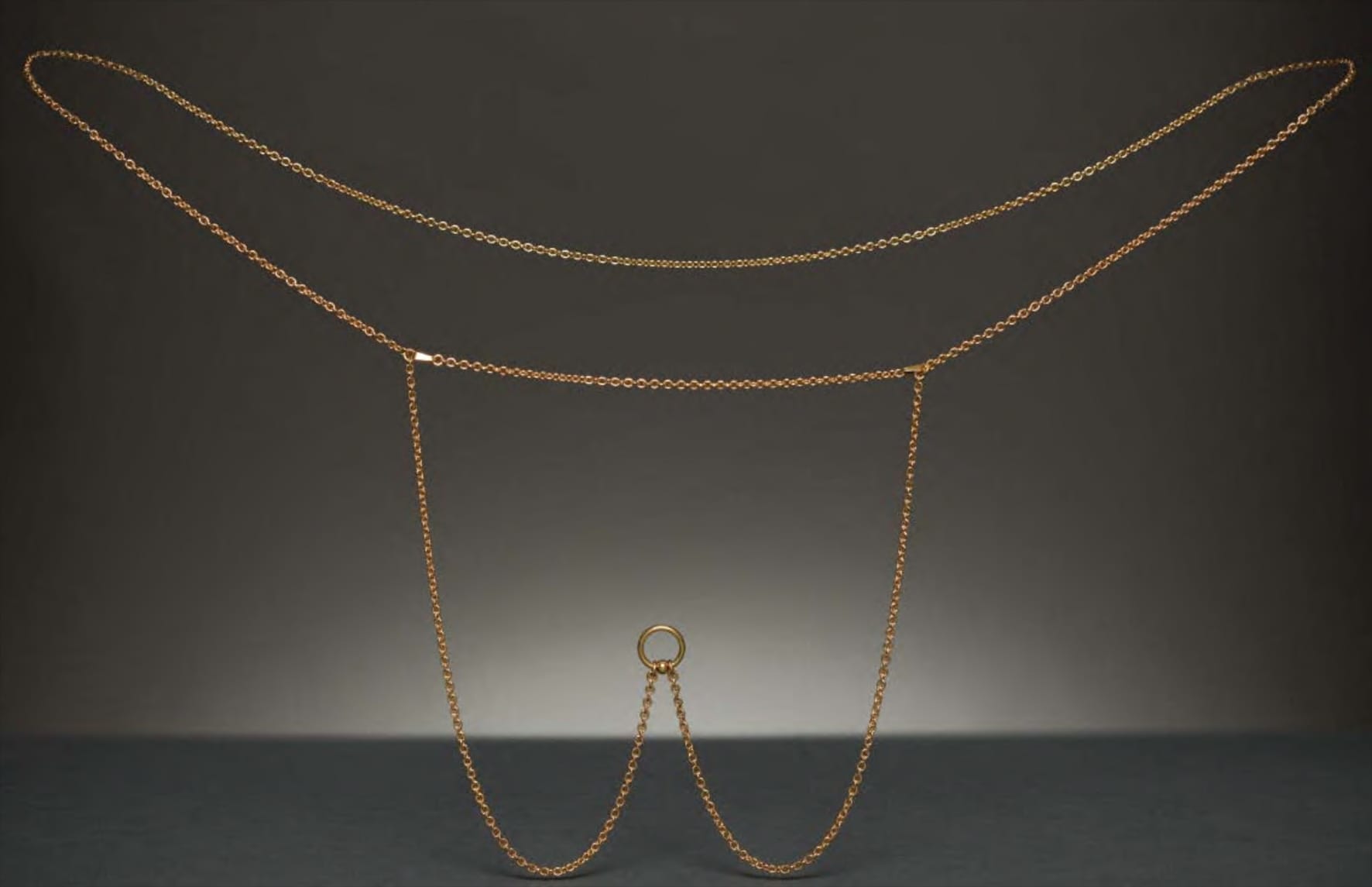
Nanna Melland – Astarte’s Gold Girdle
Agency, affect, and performance we can see acted out in, for example, Nanna Melland’s Astarte’s Gold Girdle, she the goddess of fertility and sexuality, and a master of the art of war. To quote Nanna Melland herself as she tells the story of the gold girdle “she is dangerous and perhaps even malign, but nevertheless she is also a benefactress. Rossetti’s painting of Astarte is a beautiful romantic portrayal of the goddess dressed in a green robe, fastened with two girdles. I like the painting, but I do find it far removed from Astarte’s ambiguous nature. This inspired me to make a new girdle for her. A girdle that would not only be erotic, but also a bit disturbing. I made a thin chain that would easily follow the female curves. This is not only a piece of jewellery, but also an erotic line around the waist when being worn. The ring in front is meant to pierce her clitoral hood. With this girdle, I imagine Astarte posing naked, powerfully erotic and attractive, in charge of her own sexuality, but also present with a disturbing, perhaps even dangerous nature.”
Political Material Practices
Material semiotics in contemporary jewellery intersects crucially with political critique and aspects of feminist, gender, and queer theory. Jewellery, by virtue of its bodily intimacy and social visibility, offers a potent medium for challenging dominant ideologies. Through deliberate material choices and subversive design, artists embed critical narratives into wearable forms that confront structures of power, colonial histories, environmental degradation, and gender norms.
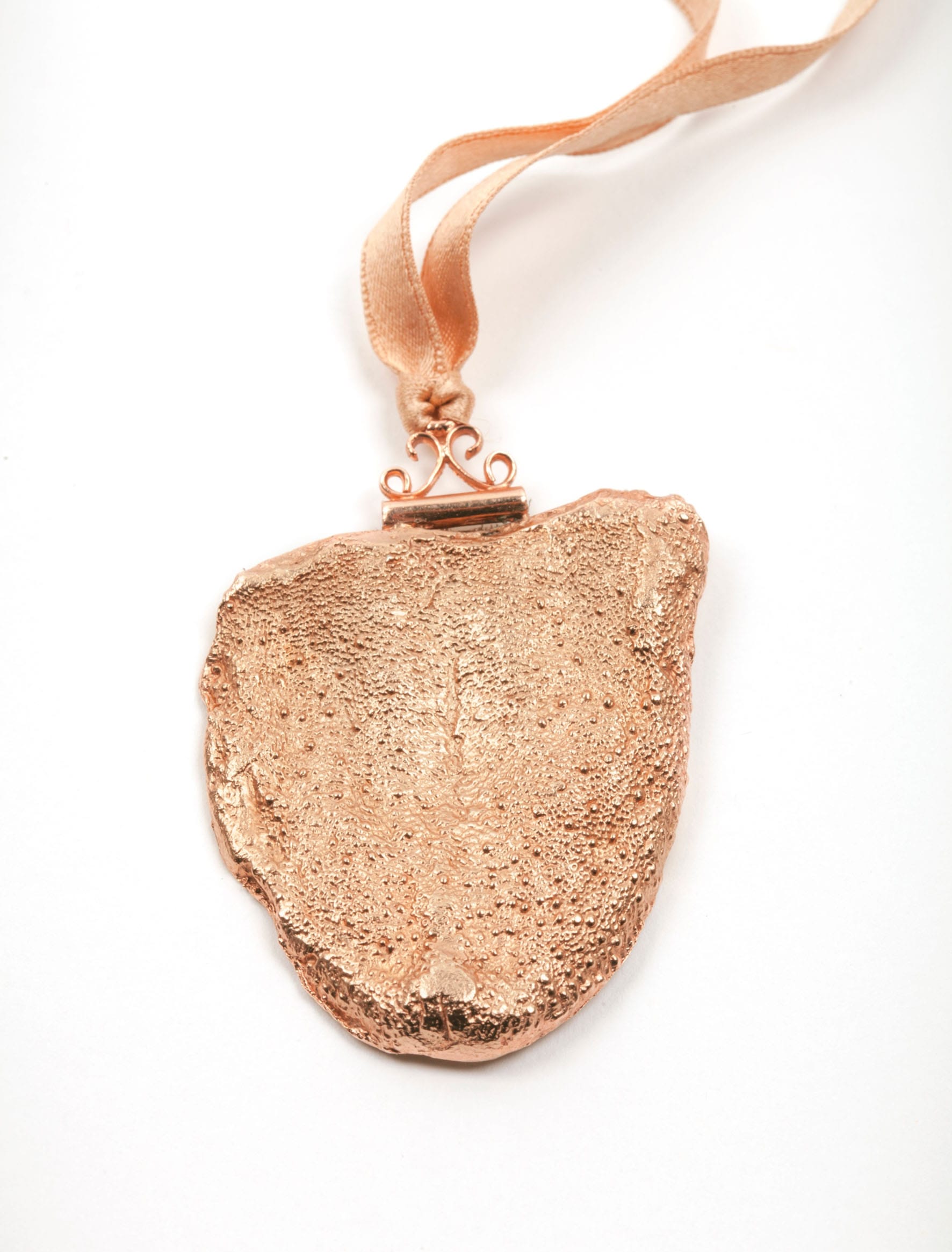
One of the key political turns in jewellery has been the rejection of precious materials such as diamonds, gold, and ivory, substances historically tied to colonial extraction, labour exploitation, and ecological harm. Contemporary jewellers increasingly turn to recycled, reclaimed, or everyday materials to critique the ideologies of purity and luxury. As Krippendorff (2006) notes in his concept of the ‘semantic turn’, objects participate in dialogue with users. Thus, the decision to use broken glass, rusted metal, or plastic waste is not merely aesthetic, it is communicative. These materials speak of consumer excess, environmental urgency, and ethical accountability. Feminist, gender, and queer material practices further expand the semiotic role of jewellery by foregrounding the body, not as an abstract concept but as lived experience. Artists work with abject or taboo materials, blood, hair, latex, saliva, skin-tone resin, to resist the sanitisation of female subjectivity for example. In Powers of Horror (1982), Julia Kristeva argues that cultural boundaries are maintained by rejecting what is seen as impure or contaminating. Jewellery that incorporates abject materials directly confronts this mechanism. A necklace made from menstrual cloth or human hair unsettles normative notions of beauty and decorum. It makes visible what culture seeks to conceal, allowing us to see our discomfort as semiotic strategy that exposes the social and cultural construction of gender, hygiene, and propriety.
Karen Barad’s (2007) theory of ‘intra-action’ pushes this further. Rather than treating meaning as something imposed upon passive matter, Barad emphasises the co-constitutive relationship between bodies, materials, and contexts. This would imply that signification arises through the entangled relationship of object, wearer, and environment. The piece does not ‘contain’ meaning, it performs it through practice and presence. Hair used in a brooch, for instance, is not a symbol of intimacy, it is intimacy, enacted and embodied. Furthermore, material practices of this kind often resist conventional forms of authorship and market logic. In this context, jewellery functions as what Jane Bennett (2010) calls ‘vibrant matter’, a site where agency and meaning are dispersed across human and non-human actors. The jewellery object becomes a lively participant in ethical inquiry. Each scratch, stain, or imperfection is a trace of labour, care, resistance, or survival.
Ultimately, the political turn in material semiotics transforms jewellery into a medium of activism. It is no longer merely about adornment or identity expression, but about intervening in systems of power. The material becomes a statement: not just what the jewellery is made of, but what it stands for, what it resists, and what it dares to imagine.
Fig.9
Noola Clooney - Tongues
Digital Materiality and Temporal Forms
The advent of digital technologies has expanded the material vocabulary of contemporary jewellery, introducing new possibilities for interaction, temporality, and semiotic complexity. Where traditional jewellery often privileged durability, weight, and preciousness, digital and post-digital practices embrace ephemerality, responsiveness, and data as material. This shift mirrors broader changes in contemporary culture, where identity and communication are increasingly mediated through digital interfaces. The material, in this case, includes the algorithm, the screen, and the gaze of the viewer. It is not static but updated, dynamic, and intertextual. Meaning arises not solely from form, but from interaction, a central principle of Barad’s (2007) theory of intra-action. The jewellery exists as a contingent event rather than a finished object.
This opens up jewellery to temporal dimensions previously inaccessible. Digital jewellery can be programmed to respond differently over time, marking anniversaries, changes in mood, or biometric data. Such time-based functions align jewellery with performance art and relational aesthetics. For example, robotic structures respond to proximity and environmental stimuli, creating an affective interface between the human and the machinic. Jewellery becomes not only expressive but sentient. Digital materiality also challenges the boundaries of ownership and authorship. Files, code, and data can be duplicated, shared, or hacked, rendering jewellery less about possession and more about participation. This democratises jewellery design, as seen in open-source jewellery communities where designs are shared and adapted globally. The material is not mined or purchased, it is downloaded, printed, iterated.
Moreover, temporality in digital jewellery resonates with broader discussions about impermanence and flux in posthuman theory. The jewellery object may be augmented, erased, or transformed with a software update. Meaning becomes fluid, refracted through networks of information and interaction. In this sense, digital materiality destabilises the idea of jewellery as a fixed artefact even further, repositioning it as an evolving platform for semiotic experimentation.
Critically, digital jewellery is not only a technological advancement but a philosophical provocation. It forces reconsideration of the boundaries between material and immaterial, private and public, signal and surface. When a brooch glows in response to social media attention or pulses with the wearer’s heartbeat, it materialises otherwise invisible phenomena. The jewellery becomes an interface, between self and society, matter and data, intimacy and exposure.
Finally, digital jewellery’s environmental implications also merit discussion. While the move away from mined materials seems eco-conscious, digital components raise new ethical concerns, e-waste, energy consumption, and data colonialism among them. Artists working with digital material must navigate these contradictions, embedding critical reflection within their practice.
Digital and temporal materials have the potential to transform contemporary jewellery into a hybrid medium, tactile and coded, embodied and networked. The object becomes not only a site of adornment or storytelling, but of technological critique and future speculation. Jewellery no longer merely survives time, it performs time, interrogates time, and evolves with it.
Fig.10
Zhilu Cheng & Jie Hao (Beijing Institute of Fashion Technology)
- Digital Thinking: A Methodology to Explore the Design of Body Artifacts
Conclusion
Material semiotics in contemporary jewellery offers a powerful framework for understanding how meaning is constructed, embodied, and communicated through objects. By moving beyond surface aesthetics and formalist traditions, contemporary jewellery, particularly in its narrative and conceptual iterations, invites a rethinking of material as discursive agent. Jewellery is no longer simply something to be worn or admired, it is something to be read, interpreted, and experienced in ways that are affective, political, and philosophical. For that reason, we can appreciate how materials are not passive carriers of intention but vibrant participants in meaning-making. Contemporary jewellery artists of this kind activate this potential by choosing materials for their semiotic resonance. These materials engage audiences in critical dialogue about identity, memory, environment, and embodiment. Furthermore, the body’s role as site of display, interaction, and affective resonance ensures that jewellery operates within a lived context. It is not placed in a vacuum but worn in motion, in memory, in relation. Each piece is thus a nexus of performative, relational, and epistemological dynamics. The wearer becomes both author and co-creator of meaning. Material semiotics also enables a re-evaluation of ethical considerations in design. The shift toward reclaimed, ephemeral, and digital materials reflects an evolving awareness of sustainability, postcolonial critique, and social responsibility. In this sense, the jewellery object becomes not only a symbolic text but an ethical proposition, an artefact that questions its own origins, implications, and potentials. Finally, by embracing instability, interpretation, and temporality, contemporary jewellery positions itself as a dynamic field of experimentation. It challenges fixed meanings and opens spaces for affective, tactile, and intellectual engagement. In doing so, it aligns with broader theoretical currents in posthumanism, new materialism, and relational aesthetics. Jewellery today does not merely adorn the body, it articulates the self, interrogates culture, and participates in the world. Material semiotics thus reveals contemporary jewellery to be a site of profound complexity, where matter is never just matter, but meaning in motion.
Signed
Prof. Jivan Astfalck
For Ethical Declaration in Academic Publishing
The author acknowledges the use of ChatGPT 4.0 (OpenAI) as a research tool in the preparation of this essay. While the model contributed to the literature research, both into Western philosophical literature regarding Semiotics after 1980, and for accessing literature regarding contemporary jewellery, the resulting content generation, all interpretations, revisions, and final decisions are solely the responsibility of the author.
Image References
• http://www. Racheldarbourne.co.uk/lovingly-murdered-images-2023/
• https://klimt02.net/jewellers/timothy-information-limited
• https://australiandesigncentre.com/past-exhibitions-and-events/madeworncontemporaryjewellery/manon-van-kouswijk/
• https://klimt02.net/jewellers/gijs-bakker
• https://klimt02.net/jewels/felicity-li-pendant-2021-please-remove-the-thorn-heart
• https://klimt02.net/jewellers/letizia-maggio
• https://klimt02.net/events/exhibitions/sting-passion-manchester-art-gallery
• https://nualaclooney.wordpress.com/tongue-pendants/www-plymouthphotostudio-co-uk-22/
• Zhilu Cheng & Jie Hao (2022) A Methodology to Explore the Design of Body Artifacts, paper presented at the HCI International Digital Thinking Conference
References
Barad, K. (2007). Meeting the Universe Halfway: Quantum Physics and the Entanglement of Matter and Meaning. Durham: Duke University Press.
Barthes, R. (1972). Mythologies. London: Jonathan Cape.
Baudrillard, J. (1996). The System of Objects. London: Verso.
Eco, U. (1976). A Theory of Semiotics. Bloomington: Indiana University Press.
Krippendorff, K. (2006). The Semantic Turn: A New Foundation for Design. Boca Raton: CRC Press.
Kristeva, J. (1982). Powers of Horror: An Essay on Abjection. New York: Columbia University Press.
Latour, B. (2005). Reassembling the Social: An Introduction to Actor-Network-Theory. Oxford: Oxford University Press.
Massumi, B. (1995). The Autonomy of Affect. Cultural Critique, 31, pp. 83–109.
Monö, R. (1997). Design for Product Understanding: The Aesthetics of Design from a Semiotic Approach. Stockholm: Liber.
Vihma, S. (1995). Products as Representations: A Semiotic and Aesthetic Study of Design Products. Helsinki: University of Art and Design.
For the original essay document please refer to the following link:
https://drive.google.com/file/d/1gZzRXQgIrGy3uA2X8GN7N7rWsLEzNb6b/